Illustrating Inkscape

inkscape-logo

The Inkscape logo.

Between actual work and a few extra-curricular gaming projects, recently I’ve faced a bunch of vector graphics tasks. Combined with a total lack of desire to boot up my ancient MacMini to use Adobe Illustrator, in doing them I’ve been experimenting with using Inkscape (on my Linux laptop) much more intensively than I ever have before. Coming in with a fair amount of familiarity with Illustrator, it’s interesting looking at the differences between them. Obviously there’s the cost, available extensions, books, the file sizes of produced content (Inkscape tends to produce much smaller files), etc., as noted in many comparisons. But they actually differ in more meaningful conceptual ways—not that a $600 sticker price difference isn’t meaningful (Inkscape is free and open source)…

A notable point in this is that I’m working from the latest development version, compiled from source from the repository. A new stable Inkscape release hasn’t been made in some time, and there are a bunch of improvements in the latest code. That said, they don’t seem to be radical improvements or additions, so for those not looking to compile from scratch, you should give the stable download a try. These notes all refer to build of Inkscape 0.48+devel r13026 (Feb 13 2014).

Objects & Strokes

A big implicit difference between the two is what are actually the first-order entities. To me, Inkscape is focused around objects while Illustrator is focused around paths. It’s a little bit of a fuzzy comparison because you can largely work on either in both. But you can see it in how the tools work, how the UI is presented, and so on. For example, in Illustrator you frequently wind up with many orphaned individual points floating around, so much so that there’s a menu option to select all unconnected points. I don’t think that can happen in Inkscape, certainly at least not easily. In general although very feasible, the tools to manipulate individual points aren’t as up-front and immediately obvious to complete beginners in Inkscape as in Illustrator. It’s just a different approach to thinking about what makes up the graphics.

Somewhat counter-intuitively then, by default Illustrator essentially treats strokes as decorators on a path (object) while Inkscape by default treats them as important, integral components of the objects. A key way this difference shows up is in calculating the dimensions of objects. In Inkscape by default the stroke width is included, so a box 32pt wide with a 1pt stroke will actually be 33pt wide. If you then manually resize the box by entering a width, say of 64pt, the box itself will be 63pt wide with a 1pt stroke (assuming you turn off the stroke scaling). Similarly, changing the stroke width will change the listed dimensions of the box. Clearly there are times this is useful, but it can make some tasks like precisely arranging objects more difficult and unmanageable. Fortunately in both system this is just a setting. In Inkscape, Edit → Preferences → Tools → Geometric Bounding Box will make strokes not be considered in calculating dimensions. In Illustrator, Edit → Preferences → General → Use Preview Bound will do the opposite and make strokes be considered. So, this isn’t in practice a huge difference since both support either style, but the different default can catch you off guard and is symptomatic of different mindsets approaching graphic design.

The kind of thing that can happen when you place objects with the strokes considered in the dimensions, and then change the strokes; these should be three stroke-overlapping boxes, i.e., just two lines visible on screen.

The kind of thing that can happen when you place objects with the strokes considered in the dimensions, and then change the strokes; these should be three stroke-overlapping boxes, i.e., just two lines visible on screen.

Hierarchy

Inkscape has a bit of a reputation of being incomplete. Unfortunately, it does indeed seem less actively developed and extensive as some other notable open source programs like GIMP. That makes sense given the comparatively smaller portion of the population out there interested in vector graphics design. Despite that rep, Inkscape is certainly very usable and stable. You can do both a lot of simple day-to-day tasks and more serious projects. It’s by no means incomplete in the sense of “Can’t be used for real work yet.”

However, once you start to use it more serious, Inkscape is unfortunately missing one or two critical things. Foremost among these to me is a more capable objects/layers view dialog. You can sort of use the XML view to do that, but it doesn’t quite work well enough. For some people it might be confusing looking at what is literally a display of the XML tree. In particular, all the XML junk often pushes the actually useful object labels, things the user actually sets to name their object, out of the view. Super annoyingly, you can’t select multiple objects in the view, and it doesn’t indicate well where objects are going to go as you’re dragging & dropping them to arrange the tree.  Layer and object visibility also cannot be controlled from this dialog, e.g., to temporarily turn something off and see other objects. All in all, it’s not nearly as nice as the hierarchy view in Illustrator. I use that panel constantly there, so its lack here is a major one for me, and nearly a deal breaker. The current hierarchical view available in Inkscape is little more than a debugging tool for developers. This seems like a comparatively simple component to add and an utterly obvious capability, so I have no idea why it’s not present.

The XML editor dialog.

The XML editor dialog.

Control

Where Inkscape does really well is having accessible, detailed controls. In that same screenshot above, up on the top right are four toggles determining whether scaling an object affects the stroke widths, if rounded corners radii scale with objects, and whether patterns and gradients move with objects. In Illustrator the stroke width option is controlled by some checkbox buried in Edit → Preferences → General. You can also set that per manipulation as a drop-down checkbox from the Transform dialog, but that then only applies to those manually specified actions. Given that this setting is something you often want to control per manipulation, and in no way a document property, Inkscape’s approach of having it up front is much more convenient. I don’t even have the vaguest idea where the other options might be in Illustrator, and doubt they exist. In particular, from the Transform box you only have the option of scaling stroke and effects together.  Unlike in Inkscape you couldn’t, for example, scale stroke but not corner radii—it’s one or the other.

Similarly, along the right of that screenshot are a ton of toggles controlling how objects snap together: On bounding boxes, along paths, at nodes, and so on. It’s a really fine grained level of control over the interface behavior. As far as I know there’s much less available in Illustrator to control how objects snap, and it’s certainly not as readily accessible to quickly modify. Unfortunately that snapping in Inkscape doesn’t always react really responsively to the actual elements as you move around, you often need to kind of hover it there before the indicator appears, an aspect Illustrator also generally isn’t ideal at. However, the conceptual intent here of utter, immediate control, is great.

As a final example of control, Inkscape has somewhat more explicit alignment controls, shown below. In Illustrator you Alt-click on an object in a selection to indicate the anchor around which the rest of the selection will be aligned. In Inkscape you have a drop-down for whether the anchor is the first or last object selected, the page, the biggest or smallest object, and several other options. Sometimes it’d be nice to be able to click on a key object directly, but this style makes it really fast to do a bunch of repetitive alignments. Options like aligning to the page are also particularly useful features somewhat lacking in Illustrator, in which you often have to make scrap or invisible objects for precisely aligning other objects. One thing that does seem to be missing in Inkscape is a really good distribution control. The tools present just don’t support quickly doing simple things like lining a bunch of objects out by X points along an axis. There are some capabilities, but you either have to deal with pre-arranging the objects into rough positions and other inconveniences, or do repeated alignments and moves.

Inkscape object alignment and distribution controls.

Inkscape object alignment and distribution controls.

Mental Game

In general, what these examples get to is that Inkscape and Illustrator just have very different mindsets about where controls go, the workflow to do different tasks, and to some extent the underlying conceptualization of graphics. It’s actually counter productive being comfortable with Illustrator as there’s such different interface style and processes in play. As another small example, double clicking on the selection tool button in Illustrator brings up a quick dialog to move an object by a specified amount, very handy for moving objects on a specific grid and such. In Inkscape that dialog is an option under the Object menu, and when open lives in the right-side bar unless you undock it. In general so far I’ve found that Inkscape does actually by and large have the tools and features I want to do real work. I just need to forget almost everything I know about manipulating the Illustrator interface and look up any questions I have, lest I incorrectly assume some feature I can’t find in the place I expect isn’t implemented in Inkscape.

As a small but important note, Inkscape is also stable like you’d expect from a normal, everyday piece of software. There is also a fair amount of documentation, blogs, and forum posts available to answer questions about particular tasks. For those that haven’t worked with Illustrator, the latter has a steep learning curve. To a large extent that’s an intrinsic aspect of any such powerful software with many features and options, but it also has a number of important keystrokes, mouse modifiers, and so on that you would not guess without reading documentation.

Inkscape also has the learning curve of any such software, but I could believe that to a newcomer—not someone coming from Illustrator—it’s actually to a large extent easier to learn. The buttons are more overt and the status bar does a better job informing you of different modifier keys and so on for the current task. Inkscape also tends to have fewer “magic” tools, and many operations have a stronger sense of a mechanical series of actions manipulating the graphics. In many ways you can feel yourself directly working on the underlying representation. If you’re at all familiar with how these graphics are captured in memory or the SVG file format you can often pretty easily conceptualize exactly what’s going on under the hood. On the one hand that can at times be frustrating and feel slow, particularly coming from an Illustrator background where many things are hidden. On the other hand, that can also make the whole process much more opaque and understandable, and that mentality is I think a large part of how and why so many options and controls wound up explicitly presented.

Conclusion

All in all, despite expected frustrations trying to transition over from Illustrator, I’m finding Inkscape pleasantly capable. Coming from that background I at first felt limited and falsely assumed a number of features and tools weren’t present. However, I’m finding less and less I can’t do as I become more acclimated to the workflow mentality, interface style, and force myself to look up features like the totally new user I actually am. Provided you’re willing to sink effort into (re-)learning, I’m encouraged to recommend it to Linux users looking for a good graphic design package, or anyone seeking a no-cost alternative.

If RebirthArt could make this in Illustrator, you can probably do whatever you need to do.  (click through for their DeviantArt page)

Example from the Inkscape homepage. If RebirthArt could make this in Inkscape, you can probably do whatever diagram or whatnot you need to do. (click through for their DeviantArt page)

PAGE Apocalypse 2014: The Defense of Kimball Prime

kingbreakers-icon

With the fall of Caldor IV and Rittenhouse Hive, yet another of Abaddon’s years-long black crusades continues to build momentum.  Gazing deep into sector holomaps, Kingbreakers’ leadership decides to make a stand on Kimball Prime.  Great works begin as the planet is made into a fortress world, with bunkers, shield generators, and innumerable weapons batteries built from the ice wastes of the poles to the sweltering jungles of the equator.  Here the traitor’s tide of war will be blunted, or the incursion will rage through the sector unstoppable.

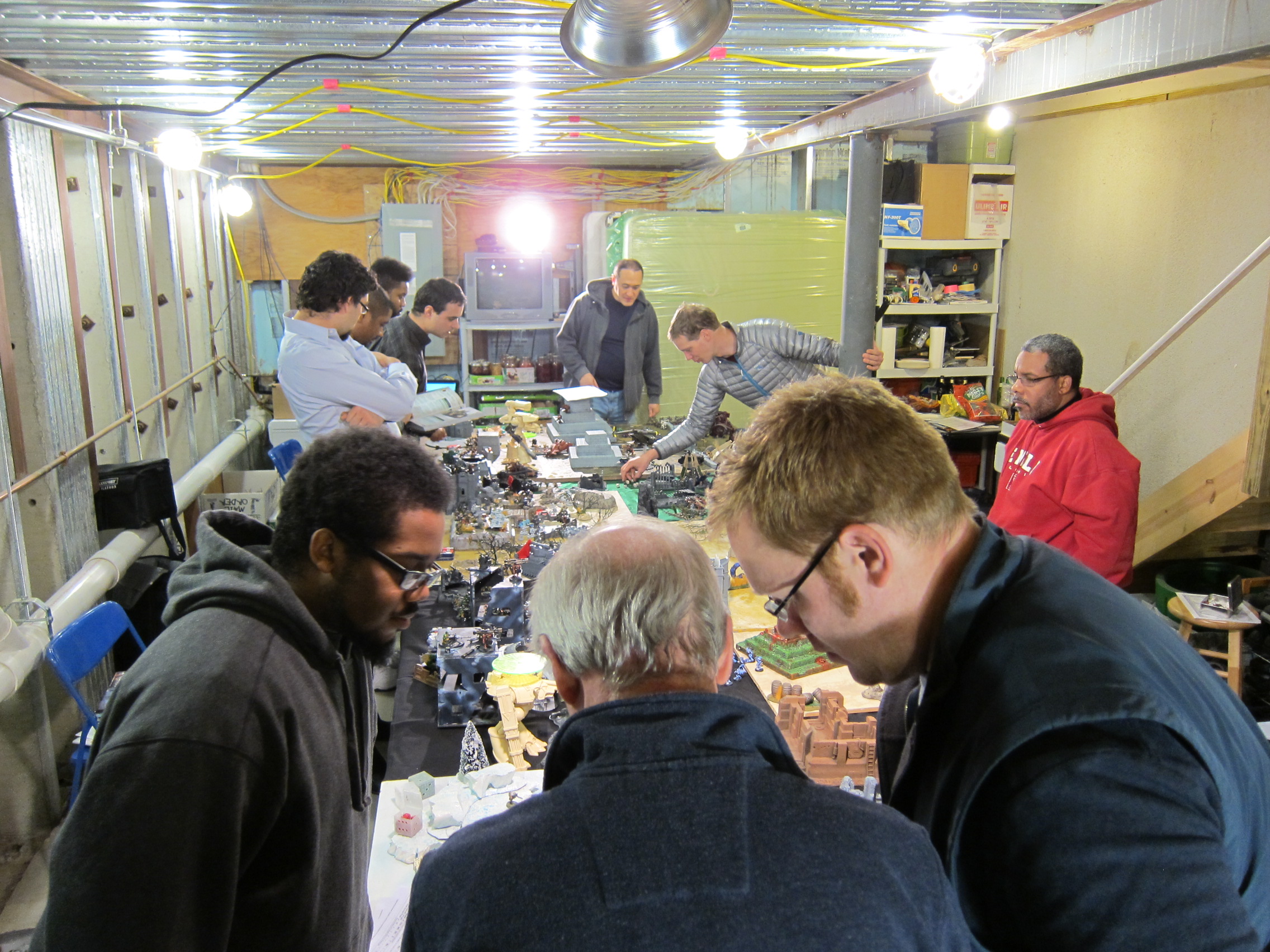
Despite a snowstorm shortly before and a variety of other hiccups, most of the PAGE crew got together for its much planned 2014 New Year’s Apocalypse this weekend, to smashing success.  Brett, Colin, Lovell, Steve, Tom, and Warren joined armies to form the Forces of Discord.  Akil, Jason, Justin, Owen, and myself made up the Forces of Order.

Lots more photos are in the Flickr gallery.

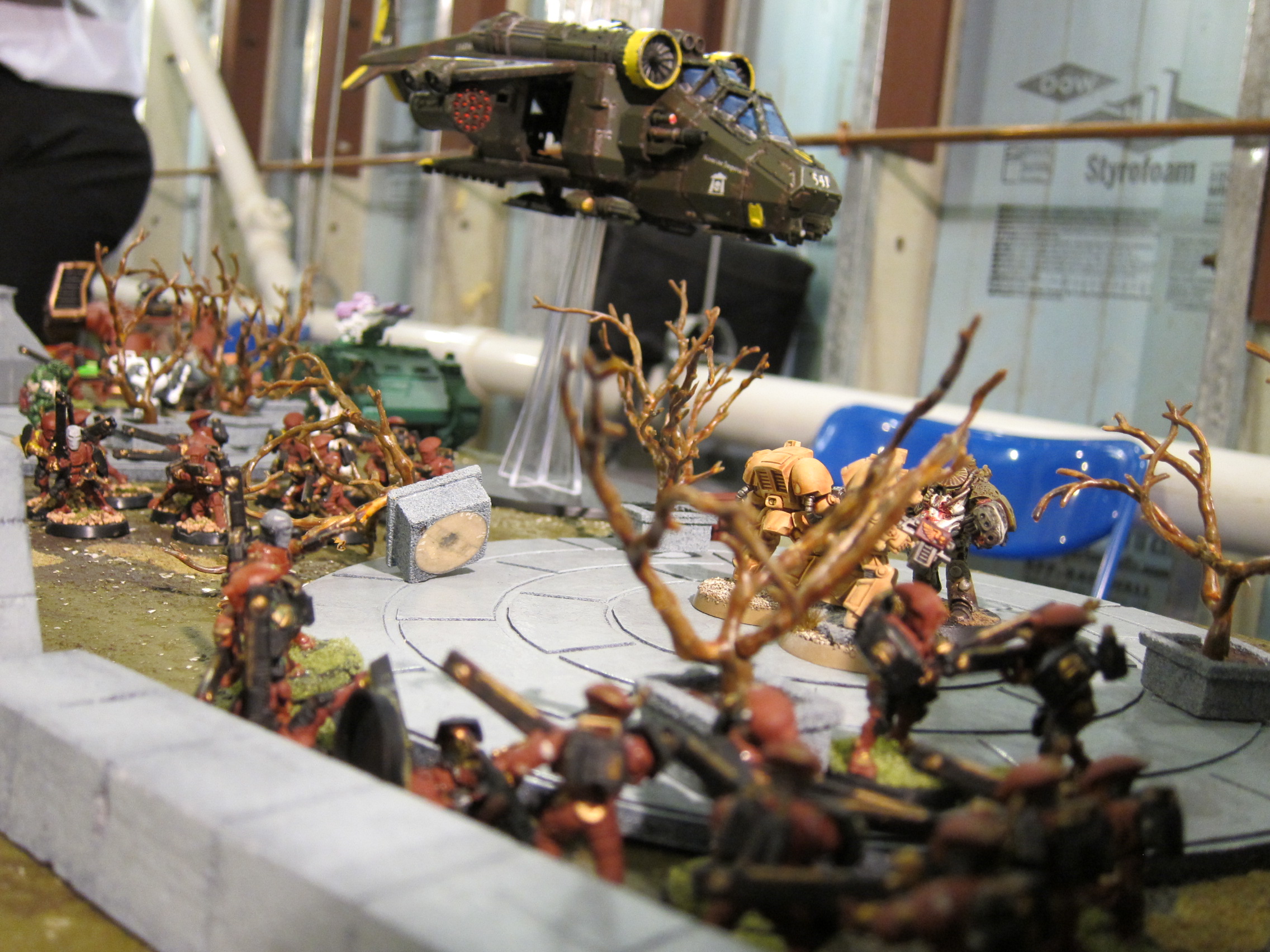
The battle underway!

The battle underway!

Listen, we could spend all day rollin' butt loads of dice, or you and me could just Rochambeau right now and get a beer?

Listen, we could spend all day rollin’ butt loads of dice, or you and me could just Rochambeau right now and get a beer?

Armies

After extensive ad hoc rebalancing for missing players—presumably caught in the Warp—the two teams came out to about 20,400 points each, from an originally planned 24,000, including all Titans, superheavies, and gargantuan creatures.  The armies of Discord brought a variety of Chaos Marines, Daemons, Cultists, Traitor Guard, and Necrons, supported by a Reaver, Warhound, a Baneblade chassis, Greater Bloodthirster of Khorne, Great Brass Scorpion, all lead by Abaddon.  The Forces of Order brought together many allies, including Space Marines, Space Wolves, Dark Angels, Tau, and Imperial Guard, supported by a Reaver, Warhound, and three Baneblade chassis, lead by Librarian Rorschach.

The planet writhes in flames as the war grinds on to near stalemate.  Finally all the hosts come to a head in a single line of battle stretching across half the planet.  Desperate times at hand, the great heroes Grimnar, Belial, and Creed together with legendary commander Farsight hurl themselves into combat at the head of great columns of men and vehicles.  Awaiting them lies a brutal gallows roll of all the mightiest foes of the Imperium, from blackest Abaddon himself to the greatest daemons of the Warp, with even the machined strategist Imhotekh and all his advisors rising from a newly awoken Tomb Citadel to throw in his lot with the bid to take down an Imperial sector.  The last push begun, Captain Angholan clasps gauntlets with his battle brother Rorschach and embarks to the front, leaving the latter and his Council of Librarians to divine the Emperor’s light and guide the forces of order.

This planet is ours now.

This planet is ours now.

Party's on the other side of the table, boys!

Party’s on the other side of the table, boys!

Scenario

The board was 6′ x 17’4″, with teams each taking a 2ft long-edge deployment zone.  Chaos won zone selection in a roll-off, and then took first turn as well after bidding 5 minutes’ deployment.  The Imperium, expecting such a low bid from the heretics and having significant foot and vehicular forces to field, bid for a full 30 minutes of setup.  Discord placed a dual set of Void Shield Generators and Vengeance Battery fortifications, with a Necron Tomb Citadel nearby.  Loyalist fortifications included multiple Imperial Bunkers, Vengeance Batteries, and a Void Shield Generator creating a 12″ protective bubble over their central position.

Heretics placed one home objective in the Citadel, another safely ensconced within the overlapping Shield Generators, and targeted an immensely important fir tree among the ice caves on the Imperial flank for their opposed objective.  Kingbreakers declared their central command buildings as tightly clustered home objectives, while the Dark Angels and Tau targeted a critical defensive wall in the jungle temple on Discord’s far right flank as the breach point through which to break the crusade.

Table setup and deployment; click for larger view.

Table setup and deployment; click for larger view.

We followed standard 6th edition Apocalypse scoring for the match: Killing superheavies, gargantuans, and the designated supreme Warmaster are each worth a point; objectives are scored at multiple times and progressively increase in value, in this case after Turns 2, 4, and 5 (game end), and for 1, 2, and 3 points per objective each time.

Let's do this thing!  Steve's scratchbuilt Warhound Titan.

Let’s do this thing! Steve’s scratchbuilt Warhound Titan.

Battle

How quickly shift the tides of war!

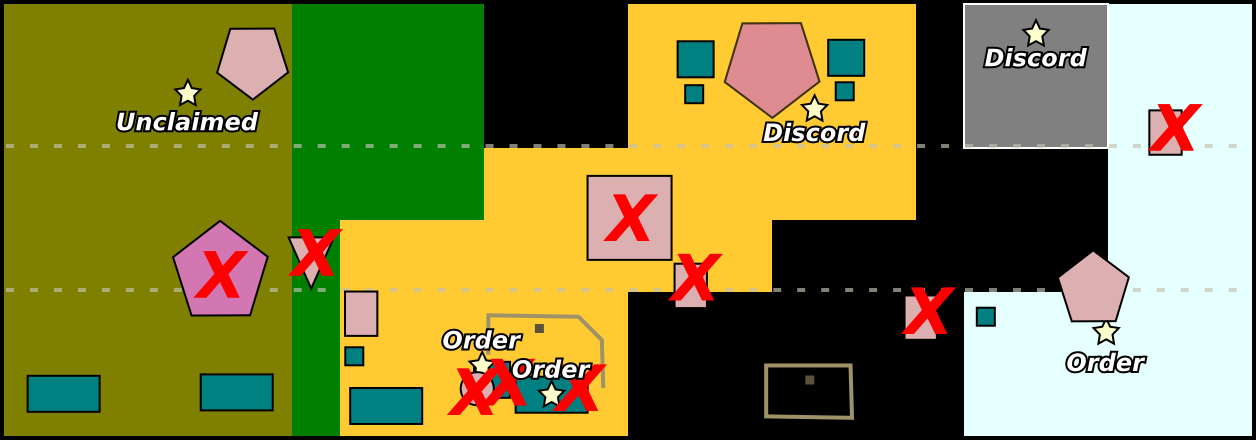
Major axes of movement & reserve arrivals; click to enlarge.

Major axes of movement & reserve arrivals; click to enlarge.

Turn 1

Combat began hectically, with the defensive Imperials in particular rushing to activate all of their comparatively numerous models and ultimately skipping a fair bit of shooting when time ran out.  Chaos declared a Trophy Kill objective on Grimnar on the Imperial right flank and began pursuing it with a massive Traitor Guard armoured spearhead combined with Abaddon himself and his Terminator bodyguards.  Innumerable daemons spawned into existence, anchored to the Materium by a host of greater daemons bursting forth from the Warp at each corner of the battle and shrouding the field in their Tetragon of Darkness.  A massive Necron Pylon came into existence in the very center of the combat, while Necron Sentry Pylons also beamed into place around the Discord objectives.  Discord claimed a Baneblade chassis while Imperials killed the Pylon to gain one point each through the course of the first turn.

Necron, Traitor Guard, and Abaddon, what could go wrong?!

Necron, Traitor Guard, and Abaddon, what could go wrong?!

Turn 2

The Emperor’s light shone brightly in the next round as the Great Brass Scorpion approached Imperial lines but fell to massed multi-melta and lascannon fire.  Chaos’ foul Tetragon was also quickly broken, with several greater daemons assassinated at their anchor points.  Imperial shooting also took out a Baneblade chassis, and all this without giving up a kill point themselves.  Further, Discord discarded their previously earned point to enact the Lies of Tzeentch Strategic Resource and temporarily control the opposing Reaver, forcing it to friendly fire and obliterate a number of Dark Angels Terminators.  Fast moving Necron Destroyers rushing from their recently awoken Citadel did manage to contest the Space Wolves’ objective, leaving Order only 2 points on objectives versus the Discord 3, but the Imperials and allies still came out ahead after Turn 2.

Ohmygod, we're so behind schedule; I need to take a break...

Ohmygod, we’re so behind schedule; I need to take a break…

Turn 3

Quickly though the clouds darkened over the Imperium.  Abaddon and friends bested Logan Grimnar in personal combat, achieving a Trophy Kill strategic asset and claiming 3 points.  Simultaneously the traitor Reaver and tank columns took down a loyalist Baneblade chassis for another point, the earth shaking crunch as its flaming pieces hit the ground second only to that of Grimnar.  These combined losses in the polar fighting left the Space Wolves distraught and open to systematic decimation in the coming turns.

Ongoing tremendous amounts of heavy shooting also did little to stop the inexorable flanking march of the Greater Bloodthirster onto the Imperial’s command bunker.  Only sustained sacrificial delaying tactics and careful positioning of many Space Marines, Imperial Guard, and Tau vehicles and infantry continued to keep it from reaching the Kingbreakers’ encampment and cracking open the critical Void Shields.  Ultimately Order gained no points and ceded its lead in the planet-wide battle royale.

For the greater good!  Blood for the Blood God!

For the greater good! Blood for the Blood God!

Turn 4

Approaching the endgame, the match pitched into a grinding battle of quarter inches and small chances.  Discord caused a cataclysmic explosion on the jungle flank by exploding the Imperial Reaver.  More damningly, the raging Bloodthirster, chosen warrior of Khorne, achieved his primary objective and crushed in a single blow the Imperials’ Void Shield Generator, exposing the command bunker and both objectives previously under its aegis.

Recovering from their mounting losses though, Order achieved several critical successes.  Hulking in screaming victory over the savaged ruins of the Shield Generator, the massive Bloodthirster was yet again lit up and wracked by fire from every possible weapon across half the field of battle and finally succumbed, sent back to its blood god at the very door of the Imperial command bunker.  The great warmonger Abaddon was similarly forced to flee the battle in the face of mounting personal injury, yielding Order 2 points for these kills.

Significantly, the Dark Angels’ long battle through the heart of an equatorial jungle temple paid dividends.  With the bulk of the Chaos flank guards tied up by the Unforgiven, the Tau, Imperial Guard, and Kingbreakers were able to sweep the targeted strategic breach point.  At the same time, Kroot reserves and Imperial Guard bombardments arrived to reinforce the Space Wolves struggling under massive combined assault and help prevent further Necron and Traitor Guard incursion.  These actions denied Discord a third objective for the second round of scoring, which awarded two objectives each.

Air cav inbound!

Air cav inbound!

Turn 5

In its last moments the epic battle for Kimball Prime reached a fever pitch of critical moves, last-chance shots, and final coups de grâce.  Resurrecting the courage of Russ, Space Wolves squadrons regrouped into secure positions overlooking the bizarrely anonymous Discord objective in their midst.  Charged thrusts from elite soldiers and fast attack vehicles of the Tau, Dark Angels, Imperial Guard, and Kingbreakers also swept away the straggling Chaos Cultists and lesser daemons attempting to resecure the breachpoint, the nearby traitor Warhound stomping in rage at its inability to stop the loyalist troops swarming about its feet.

These are not the droids you're looking for!

These are not the droids you’re looking for!

But even as the Forces of Order prepped for these advances on the flanks, Discord piled all of its remaining heavy shooting onto the Kingbreakers’ command headquarters, the Bloodthirster’s suicidal, singleminded, successful mission to cripple the Shield Generator having rendered it exposed for the first time in the battle.  With the points near tied and Discord’s two home objectives safely held but the third stripped away and Order claiming its own flank objective, everything came down to the two on the bunker complex.

With nearly all other long range shooting eliminated or crippled, the traitor Reaver and Warhound Titans combined fire to strip away the bunker’s internal Void Shields and then pummel it with the most powerful weaponry ever fielded.  They were prevented though from directly targeting the most critical troop units and the bunker itself by a well placed Shield Generator Strategic Asset, carefully saved for exactly a deeply dire moment such as this.  A precious few Forest Guard platoon members survive the incoming blasts, even as nearby Kingbreakers Tactical Squads rush in to shore them up.  The Forces of Order continued to hold their two home objectives.

The last of the flanking Obliterators dead and Skarbrand sent back to the Warp, Captain Angholan pauses to survey the battlefield and catch his breath.  His muscles all clench though and his eyes yield to horror as he turns just in time to watch a final massive overcharged plasma blast from a retreating tainted Reaver slam into the newly unshielded command bunker, instantly obliterating its top ramparts and engulfing an extraordinary area in blazing gouts of flame.  Sprinting into the blinding rockrete dust, he calls on all his decades of steely training to choke back surging memories of the fall of Forestway and his own long entrapment in the collapsed capital building.  Armor servos shriek in protest as he rips apart nanobar and flings away huge chunks of rockrete.  Finally tossing aside an entire interior wall, he falls to his knees.  Ahead of him is a large energy bubble supporting all the tremendous rubble of the upper levels.  Huddled inside are a few all-but-dead yet still living Guardsmen and Space Marines.  At the center is his great, troubled friend Rorschach and the Kingbreakers’ Council of Librarians, eyes closed and faces a rictus of concentration from the inconceivable effort of maintaining the telekinetic shield.  With Angholan frozen in relieved shock, Squad Scolirus finally catches up and slips around their Captain to begin carefully extricating the survivors.  The battle is won.

Kingbreakers dance in the flames!

Kingbreakers dance in the flames!

Results

The Forces of Order break Discord’s Apocalypse winning streak!

Reap the tallyman, Nurgle!

Reap the tallyman, Nurgle!

Order claimed 5 of the 7 possible kill points offered by the Discord forces by tagging the Pylon, Scorpion, Bloodthirster, Baneblade chassis, and the Warmaster (Abaddon), leaving the Warhound and Reaver on the table.  Order also held two objectives after Turns 2 and 4 as well as three after game end, for a total of 20 points.

Discord claimed 3 of the 6 possible bonus points offered by the Order forces by eliminating the Warhound and two Baneblade chassis, leaving the Reaver standing.  It also claimed 3 more in achieving a Trophy Kill on Grimnar, declared as one of their Strategic Asset selections.  However it spent 1 to enact Lies of Tzeentch.  Discord also held three objectives after Turn 2, as well as two after Turn 4 and game end, for a total of 18 points.

Final disposition; click to enlarge.

Final disposition; click to enlarge.

Game Thoughts

In a game like this there’s a thousand big and small things of note that happen.  These are just a couple very top level notable observations.

Range and Formations

It was really helpful to have Owen, a newcomer to our Apoc fights, be able to make the battle.  That made a big difference in equalizing the 6th edition experience levels across the two teams, helping Order play both better and within the time limits.  Tactically speaking, it was particularly helpful that he plays Guard and has played a few large battles before as he thus brought a significant increase in Order’s long range, heavy shooting.  On an 18′ long table even the normally impressive 48″ reach of a lascannon just doesn’t amount to much.  Without that we would have been in real trouble.  I was really counting on some of the missing players’ armies to provide the ability to go out offensively and hit things at distance, but the Guard shooting at range probably present a safer way to do that anyway.

Sometimes you just gotta call in the veterans.

Sometimes you just gotta call in the veterans.

Despite the story text above, my Librarians were yet again a huge, huge disappointment.  At this point I’m pretty used to how limited in appeal they are for normal play.  But I had high hopes for the Apocalypse formation I fielded, basically 5 Librarians potentially tossing out a D weapon large blast every turn.  Literally nothing walked into their line of sight and range though that wasn’t immediately swept away by much less risky shooting.  One consequence of having two redundantly Void Shielded, heavily armed encampments staring at each other across a relatively open expanse was that almost nothing ventured into what became a completely empty dead man’s land across the desert terrain.  I thought about having them disembark the bunker to get better sightlines, but even then not that many targets wandered close enough, and our little Warmaster would be out running around with giant Greater Bloodthirsters and such running amok in close quarters.  I love the models & concept so much, but…

In stark contrast to the Kingbreakers' flaming self-entombment, the Necron basically stand around all day just talkin' about how awesome their fortress is, not even noticing it blasting stuff on its own.

In stark contrast to the Kingbreakers’ flaming self-entombment, the Necron basically stand around all day just talkin’ about how awesome their fortress is, not even noticing it blasting stuff on its own.

The general point there though is that the Apocalypse formations are basically dumb.  They’re either (1) incredibly hard to field, (2) very brittle, or (3) have limited effect.  To (1), of the Space Marine formations, the majority involve fielding a full company of troops or a weird collection of very specific HQs.  On (2), a great many of their effects can be easily defeated, e.g., no one walking within two whole feet of my Librarians, or Brett’s Tetragon of Darkness being popped almost immediately.  For (3), due to the extra points available with the missing players Justin did actually field and use a Space Wolves Great Company.  But despite the large number of models and points that entails, I couldn’t tell you that I noticed the benefits.  Similarly, I actually fielded the requirements for a Space Marine Predator Assassin Squadron.  But I didn’t select the formation because it seemed more limiting than useful.

Hey, hey, buddy, don't start nothin', won't be nothin'!

Hey, hey, buddy, don’t start nothin’, won’t be nothin’!

Balance

Obviously critical to the success of all of our Apocalypse games is the effort put beforehand into balancing the headliner models.  Coincidentally but unfortunately, the Forces of Discord have many more Titans, superheavies, and gargantuans at hand than Order.  Fortunately though they have so many that there’s enough—and they’re more than willing—to share them around and balance things out.

But, to that need to put a lot of effort into balancing things, D weapons are pretty dumb.  Since they’re so strong against everything, they make everything else all uniformly worthless.  With no protection of any kind being allowed against them, there’s no reason to field anything but the cheapest possible options and put all the points toward your own D weapons.  Given that they’re both equally dead if tagged, and equally unable to strike back at the shooter, why field 14 point Marines when a 5 point Guardsman is just as useless?  A ~250 point Landraider versus a 55 point Chimera?  Previously I had mixed feelings about the recent expansion of D weapons into the regular game.  Watching them up close again though has really pushed me to be very concerned.

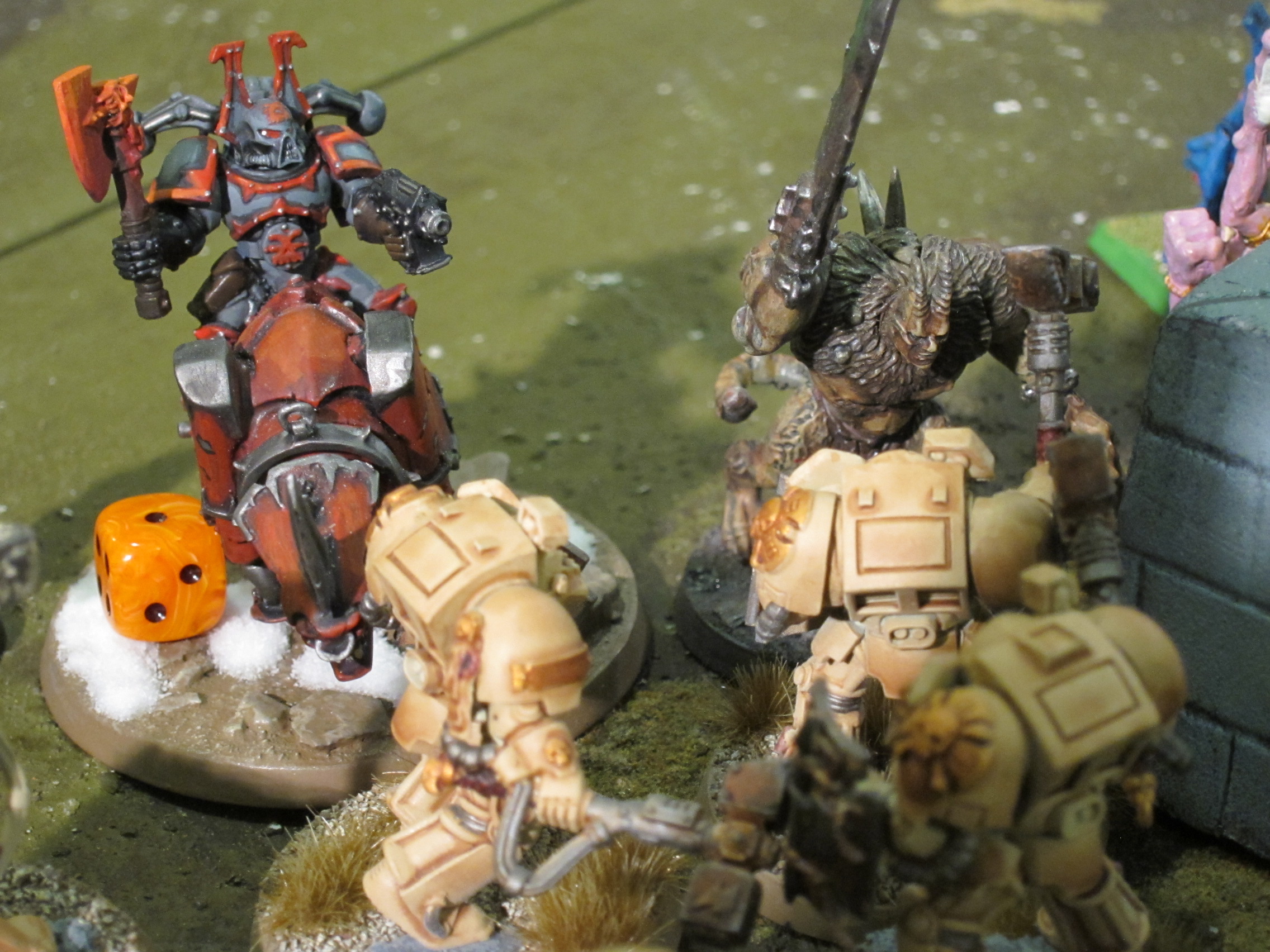
Yep...  Good luck with that axe, buddy!

Yep… Good luck with that axe, buddy!

Similarly but in the other direction, the new Void Shields fortifications are probably also a problem.  I don’t have as much of an issue with them because ultimately they don’t directly remove models, and they’re somewhat readily countered on their own as well as much more internally balanced—you do what the Bloodthirster did: Walk right in, get protected from remote shooting by the Void Shields themselves, and then smash them.  But they’re almost certainly too cheap though for such a massive buff to a potentially large number of units.

Conclusion

Beyond that, I’m going to save for another post some thoughts on organizing and executing Apocalypse battles.  Ultimately we all collectively put a lot of thought into crafting a good plan and come at the game with the right mindset, and that all paid off in overcoming near disaster with multiple missing players and instead having a truly great day of gaming.

Again, more photos are in the Flickr gallery.  Till next time; the Emperor protects!

Huh... I guess he's really good with that axe?  Sergeant Harmon contests the Discord flank objective!

Huh… I guess he’s really good with that axe? Sergeant Harmon contests the Discord flank objective!

Beevor’s ‘The Second World War’

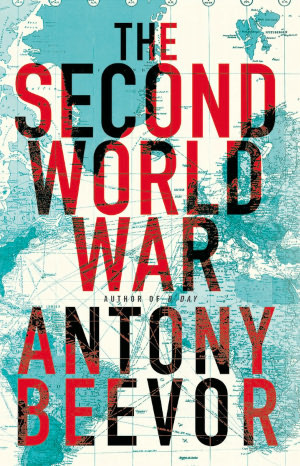
beevorEarly this year I picked up Antony Beevor’s 2012 history book The Second World War on the recommendation of Ta-Nahesi Coates (here and here), and recently I finally read it.  The book is actually somewhat complex to evaluate.  Most reviews (NY Times, Guardian, etc.) seem to have been positive but not super excited about the effort.  At first I agreed but now feel it to be an excellent book within its audience, goals, and necessary limitations.  It is certainly by far the best single-volume history of the entire war that I have encountered.

Audience

The first tough question to evaluate is who exactly is the audience for this book?  I found it to be a fast read but at almost 800 pages (excluding bibliography) it is probably a significant commitment for many people.  Beyond that, it is mired in details of dates, titles, numbers, troop dispositions, and so on.  Not getting bogged down in these while also not missing important notes or losing track of the overall thread and continuity could be challenging for younger or less experienced readers.  Similarly, those only marginally interested in the topic could potentially be turned off by its sheer length and the volume of nuts & bolts minutia.

From a different angle, those who are very interested and have read a lot about the second world war may at times be a bit confused about what they’re supposed to get out of the text.  Surprisingly given the many decades between the event and now, Beevor does actually present a number of new revelations that have only recently entered public knowledge.  But the overall text is very light on analysis and motivations, and the basic detailed history already well covered in innumerable texts and documentaries, so for those well versed in the topic it’s not always immediately clear for what or whom the book is intended.

Ground History

Eventually though I came to understand the book as a detailed ground history across the entire scope of WW2.  At that it is impressively detailed yet readable.  If you want to get or ensure you have a comprehensive feel for the military movements across all of the half dozen or so major fronts in the war, this is the text you want.  In this way it’s useful for both those unfamiliar with the topic, and those who want to cement their knowledge.  Beevor himself notes that he wrote the book because, having written several other books about particular battles and topics, he thought his own knowledge was patchy.  As one example for me, though broadly familiar with the fighting and politics in China, the overall picture and the specifics of the intense jockeying for post war positioning between the Nationalists and the Communists is much more clear now.

That leads directly to the first place the book really excels.  It covers the whole war.  From an American perspective this makes it a particularly useful text.  All of the early movements in Czechoslovakia and Poland, the critical nature and immense scope of the Eastern Front, to the Italian and African campaigns, to the overlooked but long-term incredibly important China and Southeast Asian theaters, everything’s covered.  This isn’t a typical American history in which the war is largely fought and won over 4 days (e.g., Pearl Harbor, D-Day, Iwo Jima, Hiroshima).  The Battle of Britain, for example, gets a reasonable but notably succinct summary, which makes much sense upon reflection:  That conflict’s extremely well covered elsewhere and, though immensely important, actually very simple and straightforward in the basics.  In contrast, a tremendous number of pages is spent on the sprawling, complex, and ultimately world defining Eastern Front, a theater that has little detailed recognition and understanding among western audiences.  As another personal example, though relatively very aware of the scope of Soviet and German losses, and the sheer brutality of that conflict in particular, the book adds a layer of general understanding to the overall sweep and movement of the war.  It also clarifies a number of details, e.g., the final Soviet and US run-in to Berlin, a relatively small but ultimately very consequential period of time of which it turns out I did not understand the basic mechanics well at all.

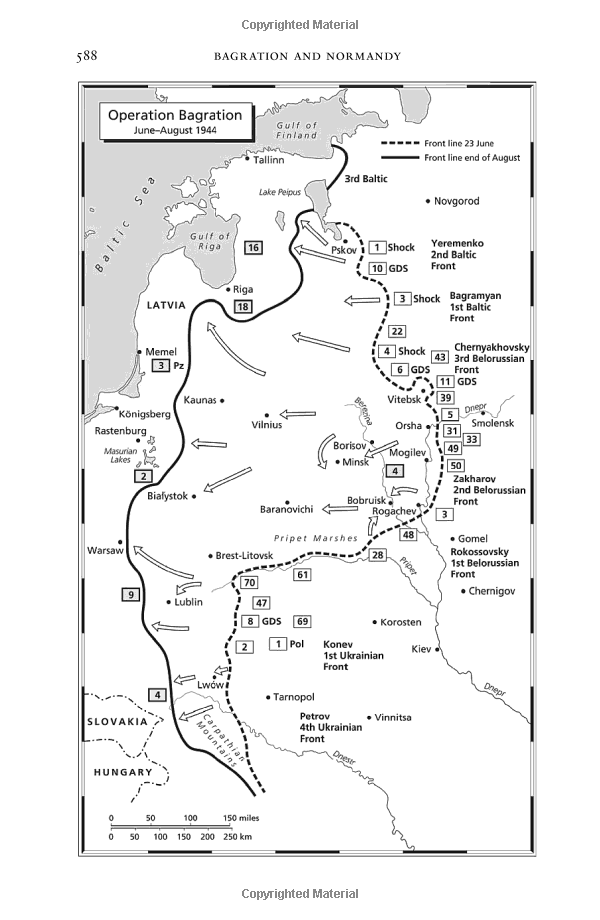
Map from the text of a late war overarching Soviet push.

Map from the text of a late war overarching Soviet push.

To the point about brutality, that’s where the book really excels.  It’s important to recognize and understand that the text comes from classical, traditional military histories of major conflicts.  Though the coverage is reasonable for the book’s purposes, Beevor only tangentially discusses the politics, economics, and scientific enterprises that are the real heart of the issue in the war.  If you’re looking directly for analysis, contextual understanding, and long term consequences, as I was going in, this is not that text.  It starts from a focus on armies and generals and combat and stays focused on that kind of ground level details of the war.

But Second World War goes well beyond that class of ultimately unenlightening typical military narrative in being very comprehensive about what it means to be a “detailed ground history across the entire scope of WW2.”  There is extensive discussion about the suffering of individual soldiers and the conditions they fought under.  More importantly, despite the book’s military history origins, Beevor places equal focus on the devastating, incomprehensible levels of civilian suffering, elevating the text well above most generic WW2 histories.  Both abstract issues and numbers as well as a wide array of personal letters and diaries are used to document that aspect of the war as extensively as the military maneuvers.  It documents well topics like the courses of both Nazi and Soviet genocide; unbelievable losses of life to famine in China and Southeast Asia; and the awful, unrelenting destruction and poverty of the churned middle ground between Russia and Germany.

The book also puts special attention to the near universal suffering and persecution of women on all fronts.  To a large extent this is not a revelation to any who have read about or are otherwise familiar with events like the Rape of Nanking, or, indeed, has thought at all about the likely consequences of an extended, to-the-death, wide scale war, particularly one with heavy racial and nationalist undertones.  But this is a topic still under-discussed and poorly recognized, e.g., among all the pop fans of WW2 enabling the thriving history-entertainment industry.  Beevor also pushes that understanding into all theaters and forces the unavoidable conclusion that this is not an issue of ad hoc atrocities or confined to just one region.  The text makes clear both the overwhelming extent and horrifying nature of female suffering across the entire worldwide conflict, as well as its execution as a systematic, condoned, even organized undertaking.

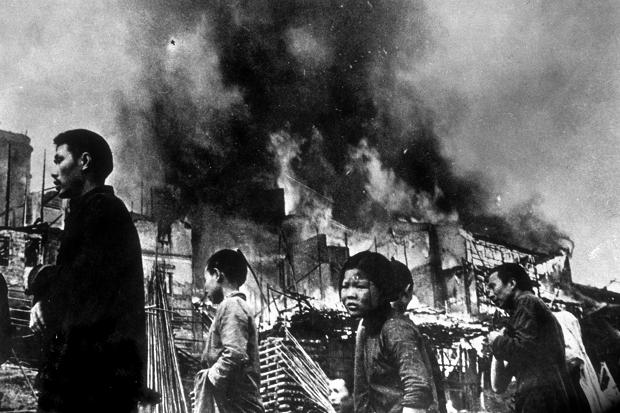
Chinese refugees in Chungking, wrecked capital of the Nationalists.

Chinese refugees in Chungking, wrecked capital of the Nationalists.

Details and Revelations

As has been widely publicized in other reviews, the book does work to raise popular awareness of a number of relatively new revelations.  Some of these include:

  • A somewhat notable assassination of a Vichy French official, not previously understood to be organized by the British and US intelligence services.
  • The treatment of Soviet women by the Soviet army itself, the uncovering of which I believe comes largely came from Beevor’s own work for his more focused book Stalingrad.
  • Most talked about, the overwhelming effect of starvation on Japanese forces—60% of all casualties—and the consequent systematized, rampant cannibalism among its armies.  This has only recently been captured by Japanese historians after being suppressed by the Allies in order to not traumatize families of POWs at home.

Just given the breadth of the material, the book necessarily has to make concessions to brevity.  Many reviews have noted that compared to Beevor’s previous books there is less emphasis on personal accoutings.  Still though, I think there is a good amount of that, with many of the scenes, particularly of refugee and other civilian suffering, told through diaries and letters.

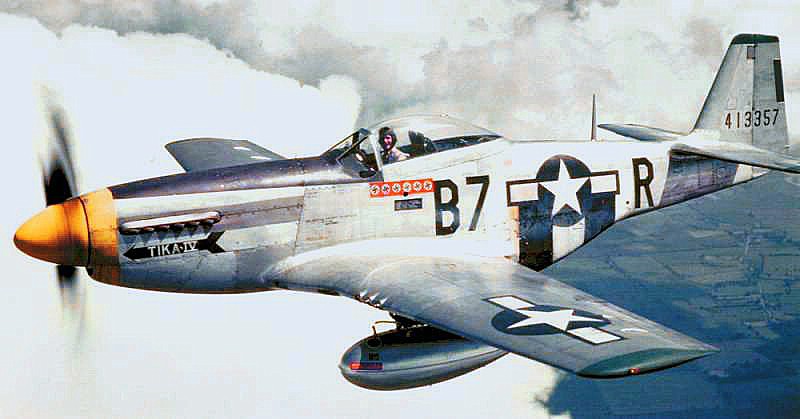
Similarly, in many ways the book relies a fair bit on extensive knowledge of the war.  For example, there’s a line in a meeting with Churchill about Stalin’s blue pencil that has no resonance without knowing his original role as an editor.  As a more important example, I’m not sure the book adequately relates the technical limitations forcing the Allies’ unescorted bomber tactics in Europe until the development of the Mustang fighter with its combination of range and capability.

One of the most important engineering efforts ever...  Still not as powerful as Stalin's blue pencil.

One of the most important engineering efforts ever… Still not as powerful as Stalin’s blue pencil.

Some of these choices though come directly on the book’s focus on the ground, and are reasonable once you’re in line with that approach.  For example, there’s an interesting paragraph or so about driving in the London blackout, and the thousands of pedestrians killed by vehicular accidents in its early months.  In contrast, the massive, world-changing Manhattan Project appears almost out of nowhere only when the Enola Gay finally takes off on its fateful mission, with just a few references beforehand as it came up in conferences among the Allied leaders.

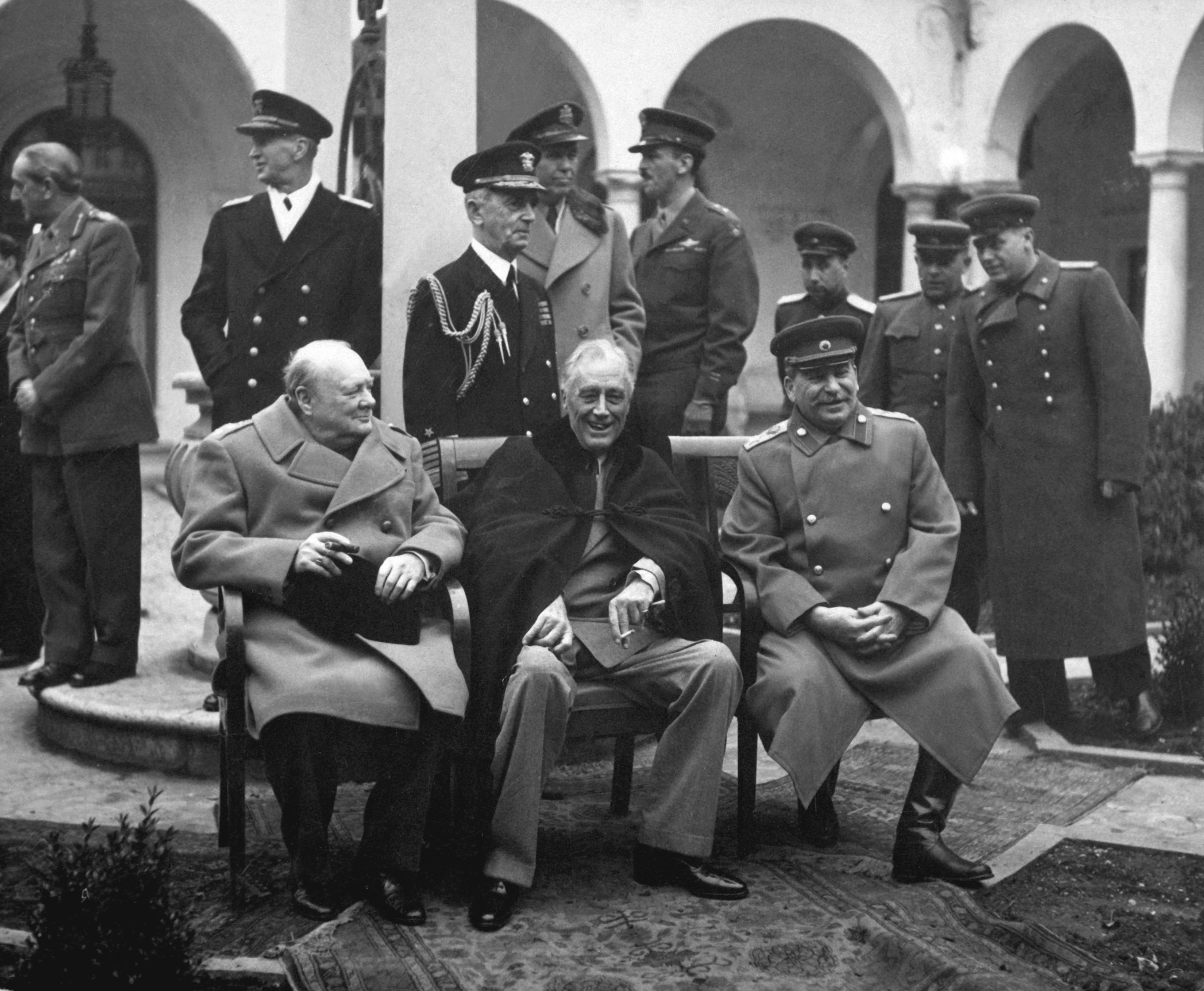
To me, among the more notable non-ground details Second World War does make within its comparatively limited focus on the leadership and behind-the-scenes politics, are those about Roosevelt.  Beevor paints a clear picture of his anti-Imperialist leanings, capturing how that defined US priorities, frustrated Churchill, and would have resulted in an immensely different world view had he lived longer.  For example, it discusses in passing references how he was staunchly against the French resuming occupation of Indochina (Vietnam) after the war.  Though it’s hard to predict how that would change history, clearly it would do some immensely.  In a related vein, it is also made clear just how poorly Roosevelt understood or cared about post-war implications, how fixated on them Churchill was—often in strongly Imperialist tones—and how masterfully Stalin and Mao Zedong out-maneuvered both of them at that shadow conflict.

"We're getting played, arent't we?  Hilarious!"

“We’re getting played, arent’t we? Hilarious!”

Maps & Endnotes

As a minor note, the first half or so could use a few more maps and diagrams, but I attribute that to Beevor being English and assuming more familiarity with European geography than I, and presumably most Americans, possess.  By the time things get really hairy and entangled in the second half of the war, much of it in the less familiar eastern Europe and Pacific, there are notably more diagrams complementing the text.

On another minor note, the book employs extensive endnotes rather than footnotes.  I assume this was done to make the book seem more pop history and accessible to people flipping through in a bookstore.  It’s very unfortunate however as it leaves you constantly wondering “Who said that?” and “Where is he getting that from?” for both quotes and newer revelations, giving the book just a slight feel of unscholarlyness and speculation that it doesn’t deserve.

Summary

All in all, I highly recommend Beevor’s The Second World War, contingent on being clear or what the book is trying to do and who it’s for.  It’s not a light history, and probably requires either a fair amount of motivation or an experienced reader; e.g., I have mixed feelings about recommended it for typical high schoolers.  Little time is spent on politics, economics, context, or consequences.  Similarly, there is little analysis or direct relation to modern events.  Beevor himself is careful in interviews to proscribe against the popular inclination of politicians and pundits to draw untrue and misleading parallels to WW2.  But the book is very good for those with a limited understanding of the basic mechanics and movement of the war, or those who want to ensure their understanding.

Beyond that, the book is excellent at is portraying the “truth” on the ground.  Most notably, it is faithful to and evenly balanced across the entire scope of the war—from the Pacific to the Eastern to the Western fronts—as well as both the military and civilian effects, particularly for women.  The scope and abstract numbers almost prevent a felt understanding, but there is enough detail and personal accounts to ensure a tangible picture of the colossal scale of human suffering entailed.

Ultimately that presentation is worthwhile in its own right, and enables the kind of thought and analysis from which the book largely shies away.  For example, through much of the text the US and English come off fairly well in ethical terms, with most of the atrocities, particularly mass rapes,  enacted by the Japanese, Germans, Soviets, and French.  Especially at the end though there are disappointing lapses by US forces in the occupation of Japan.  Combined with the deep picture from the rest of the text of the relatively limited contact up to that point between US forces and civilians, particularly non-Europeans, it is difficult to not then take that behavior as near-universal and those two Allies’ comparatively clean records coincidental rather than actually exceptional.

That is exactly the sort of observation a good raw history should support.  Second World War largely refrains from imposing its own conclusions, but does enable that kind of thinking across a number of topics: Civilian suffering, modern total war, justification for the atomic bombings, post-war geopolitical consequences, and so on.  For that I highly recommend it.

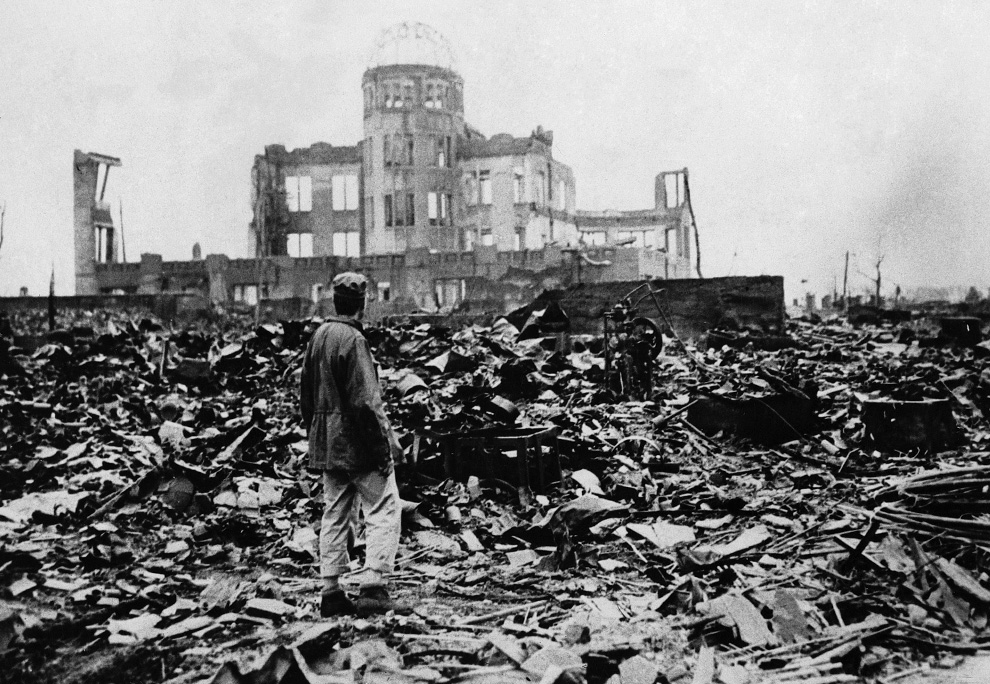
Hiroshima.

Hiroshima.