3D Printing for Wargaming Scratchbuilding

Recently I got a 3D printer and have been having a great time with it. My more general thoughts about the technology I’ve already posted. Here I present a quick walkthrough of one of my immediate, highly critical and urgent, applications for the tool: Making detailed parts for miniatures wargaming terrain.

Design

Recently I scratchbuilt a small facility for a new set of terrain I’m working on for my club’s upcoming LibertyHammer event. One of the little bits built to provide some detail and texture to the model’s overall look is a simple antenna cluster.
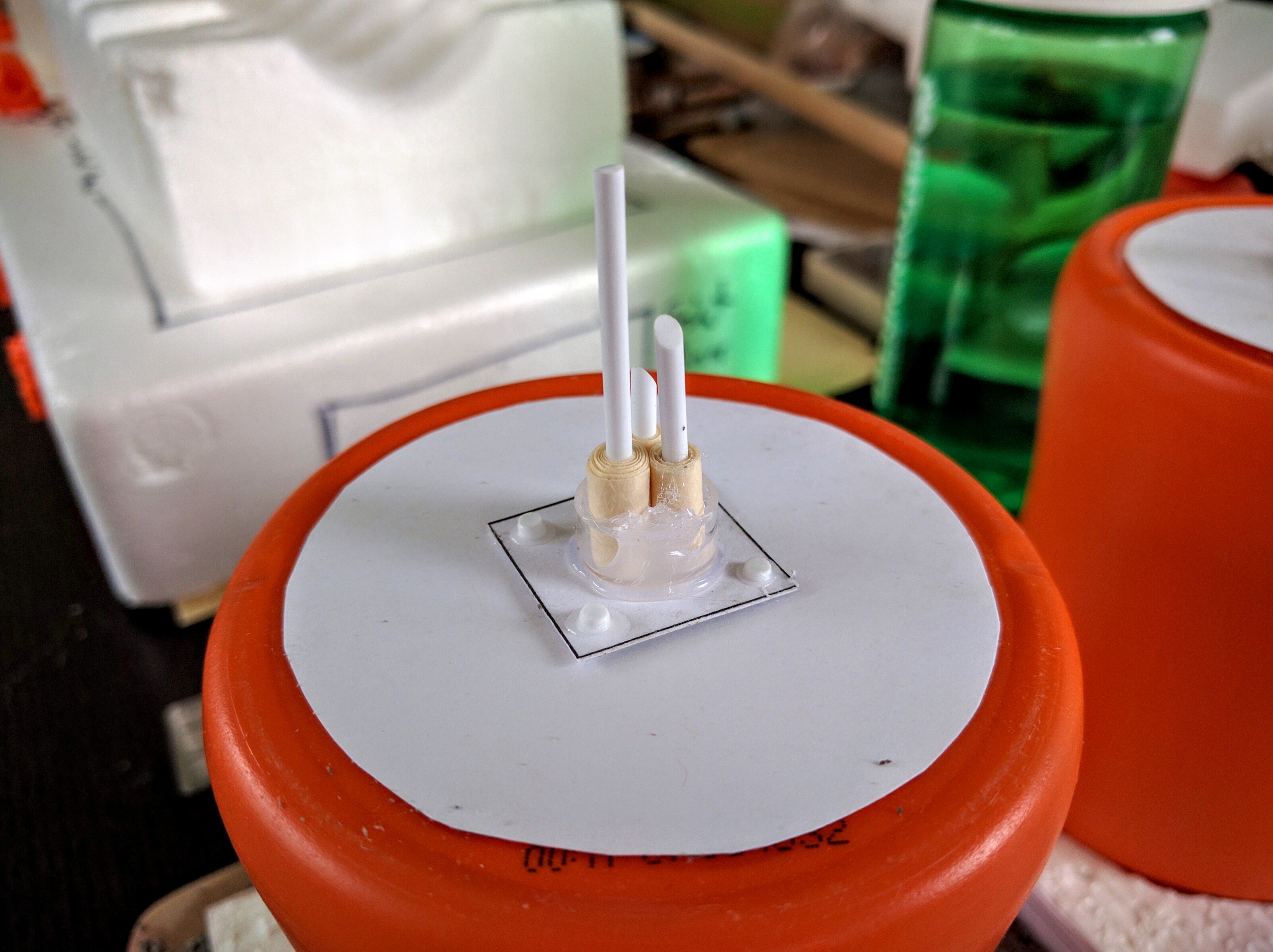
Scratchbuilt antenna array.

Scratchbuilt antenna array.

That prototype turned out pretty well, so now I’d like to have a bunch of them to stick on various buildings in the set. They’re not hard to make so they’re not worth the hassle, cost, or time to resin cast (though it would be straightforward to do so because of the verticality and flat bottom plane of the shape). With the 3D printer though I can make a tradeoff: It’ll actually take longer to produce, almost 30 minutes on my printer at high detail versus maybe 10 minutes for me to make by hand. But I can do other things in that time, and they’ll be more consistent, more detailed, and I don’t have to scrounge around for supplies and components.

To do so of course I have to create a 3D model. For this project I used TinkerCAD, a simple browser-based 3D computer aided design (CAD) program from Autodesk. The end result is faithful to the scratchbuild, with just a few more details.
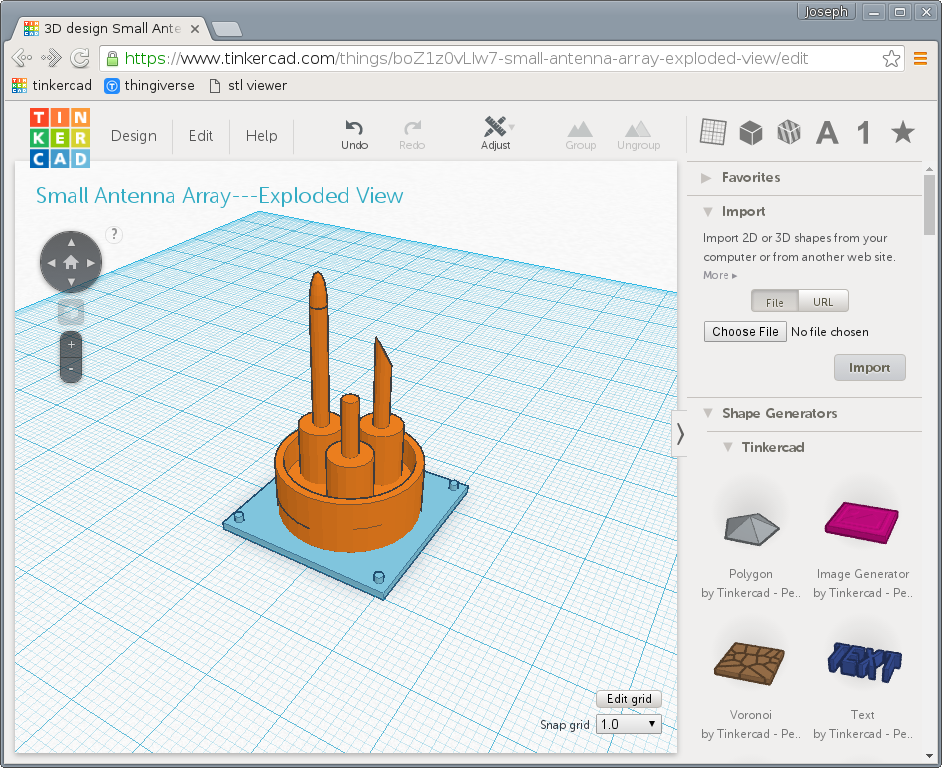
The finished antenna array in TinkerCAD.

The finished antenna array in TinkerCAD.

TinkerCAD is essentially a constructive solid geometry modeler. Its core operation is constructing complex shapes by adding and subtracting simpler shapes to and from each other (unfortunately it does not seem to support the third constructive geometry primitive operation, intersection). For example, to put a hole through a cube you take a cube and a cylinder and subtract the latter. To make a farm silo you would take a cylinder and add a sphere sunk halfway into the top.

One advantage of this paradigm is that the final product is guaranteed to be solid. In mathematical terms, every point in space is completely determined to be inside, outside, or on the surface of the shape. Intuitively, the 3D shape is watertight, there is no way to pass between the common sense exterior and interior. This property is critical because it’s essentially required in order to print a model. Although there are other approaches to working with solids besides constructive geometry, not all 3D modeling approaches are based on solid forms and may not guarantee that property and be as directly applicable to representing physical artifacts. For example, many tools oriented toward video game and animation modeling are based around manipulating arbitrary 3-dimensional meshes of polygons, which aren’t necessarily solid and may not be printable because no algorithm can determine what is inside and what is outside the piece.

Another feature of constructive solid geometry is that it’s comparatively easy to make many kinds of modifications to the part later on, because the sequence of steps and feature composition of the part is naturally retained in its model.

A downside of constructive geometry though is that it can be difficult or actually formally impossible to create some complex shapes. Fortunately though, the style is well suited to making many types of mechanical parts, as well as many kinds of wargaming models, especially mechanical or industrial terrain. The antenna cluster for example is mostly just a few cylinders of varying sizes, a base plate, a negative cylinder to create a pocket forming a partial wall around the antennas, and another pyramidal hole slicing an angle off the top of one antenna.
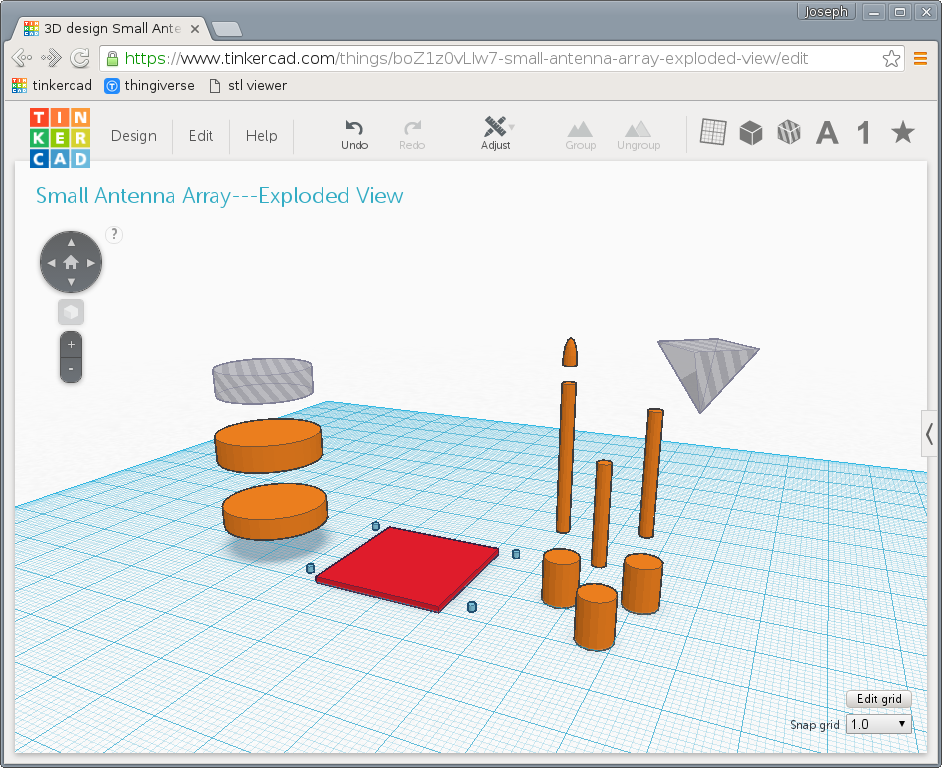
Constituent parts of the antenna array model. The gray semi-transparent parts are holes, negative shapes. The other colors have no meaning.

Constituent parts of the antenna array model. The gray semi-transparent parts are holes, negative shapes. The other colors have no meaning.

Printing

The part is then exported to STL, a STereoLithography file. This is one of the primary file formats common across CAD software and is ubiquitous in 3D printing. Stereolithography is actually one of the earliest forms of 3D printing, and the basic principles are still widely used, particularly for very high resolution printers. One of the reasons for the STL format’s enduring popularity beyond those early tools though is its simplicity: The entire model is represented as a collection of triangles making up a polygonal mesh. That’s essentially a lowest common denominator for working in 3D, so it’s easy for software developers to import and export.
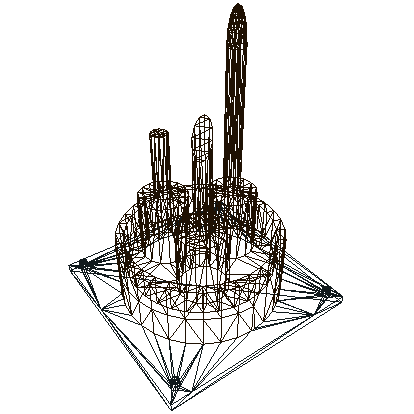
View of the STL triangular mesh, from viewstl.com.

View of the STL triangular mesh, from viewstl.com.

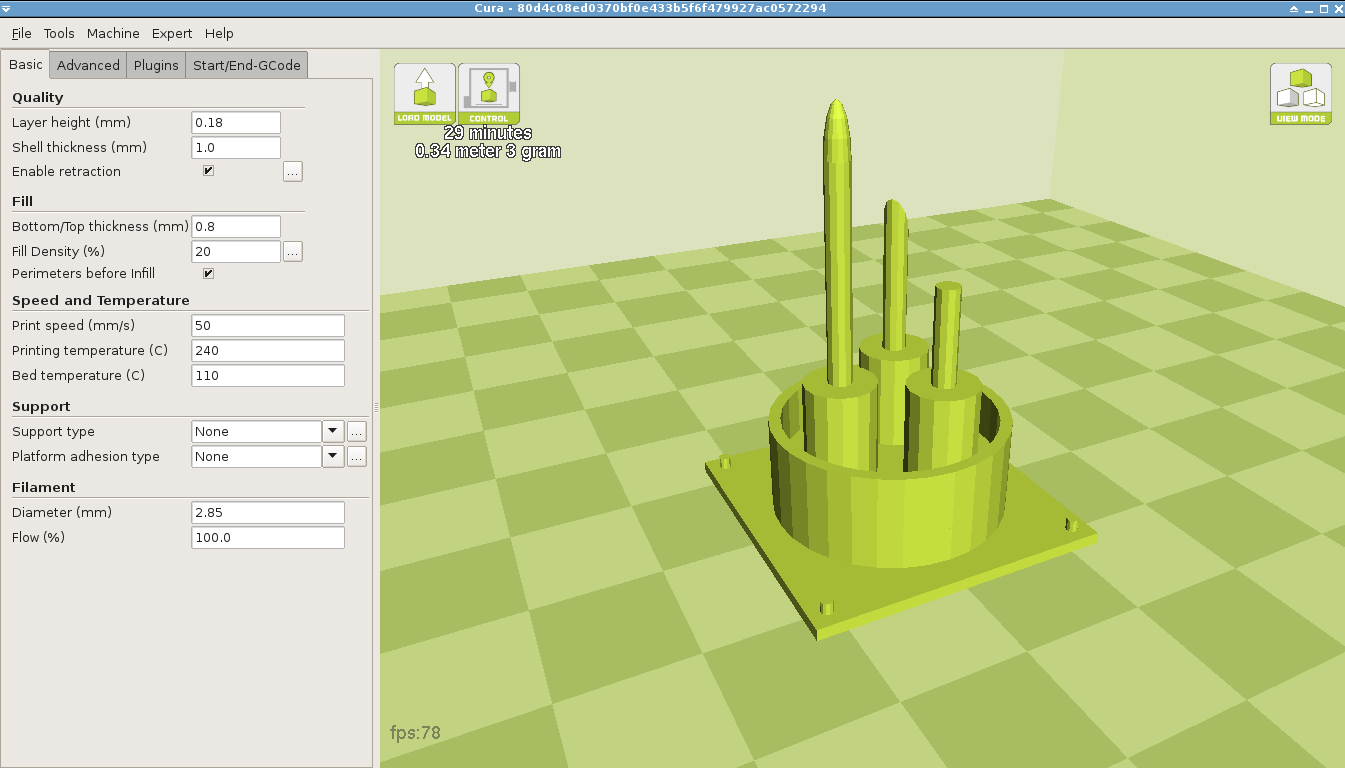
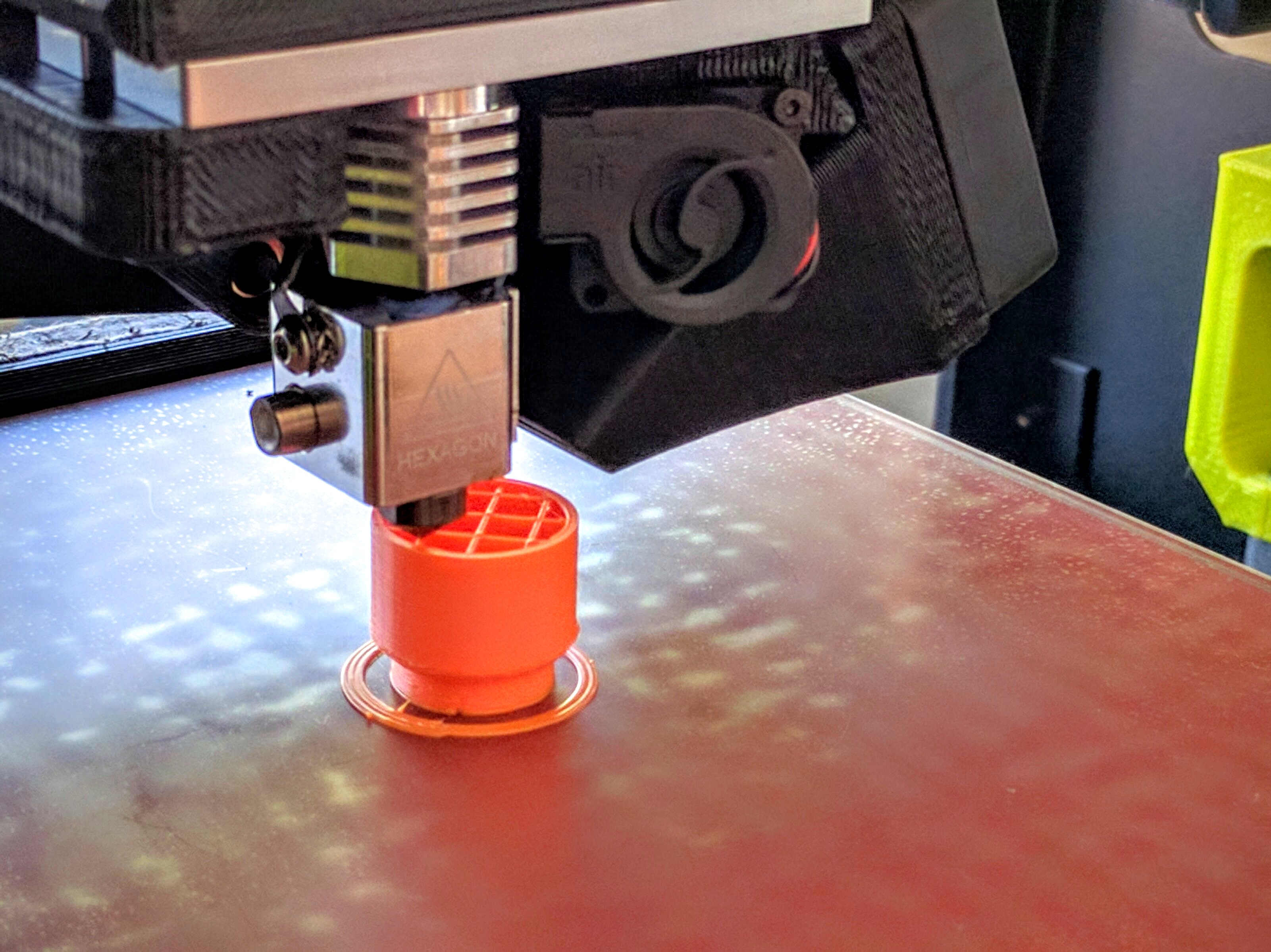
Like most home 3D printers, mine is a fused deposition modeler. A strand of material, usually some type of plastic filament but not always, is heated and extruded through the printer head. Servos move that printer head or part workbed around to outline and fill a single horizontal 2D slice of the part. The head is then moved up relative to the workbed to deposit another slice on top of that. Working from bottom to top, eventually a 3D part is constructed. Slicer software is responsible for taking the STL file and cutting the shape up into thousands of layers, then generating the movement commands to drive the print head.
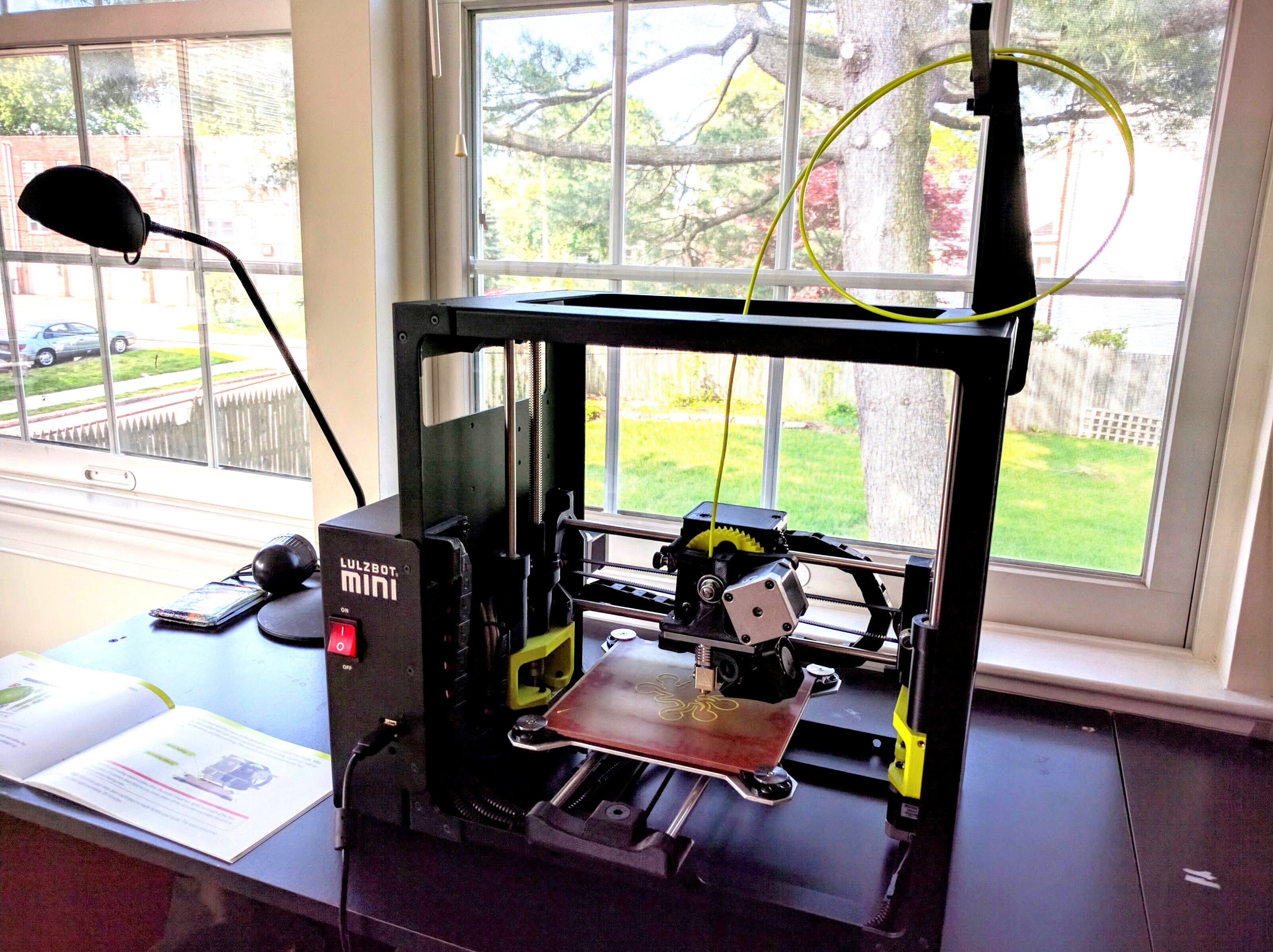
My Lulzbot Mini.
My Lulzbot Mini.

The antenna ready to print in Cura, a popular slicing and control package.
The antenna ready to print in Cura, a popular slicing and control package.

Printing a (different) part. Solid shapes are generally filled with an infill pattern, here the visible cross-grid, to maintain strength and form while dramatically reducing material and print time.

Printing a (different) part. Solid shapes are generally filled with an infill pattern, here the visible cross-grid, to maintain strength and form while dramatically reducing material and print time.

Of course there are numerous details beyond that quick summary: Material; layer height; printer speed; supports, rafts, and brims for enabling more complex shapes; and so on. But with some printers and software these days, and with appropriate models, it really can be basically as simple as just loading up the model and clicking “Print.” With my printer and settings this small antenna array takes about 30 minutes to print, and afterward I’ve got a sweet little terrain bit.
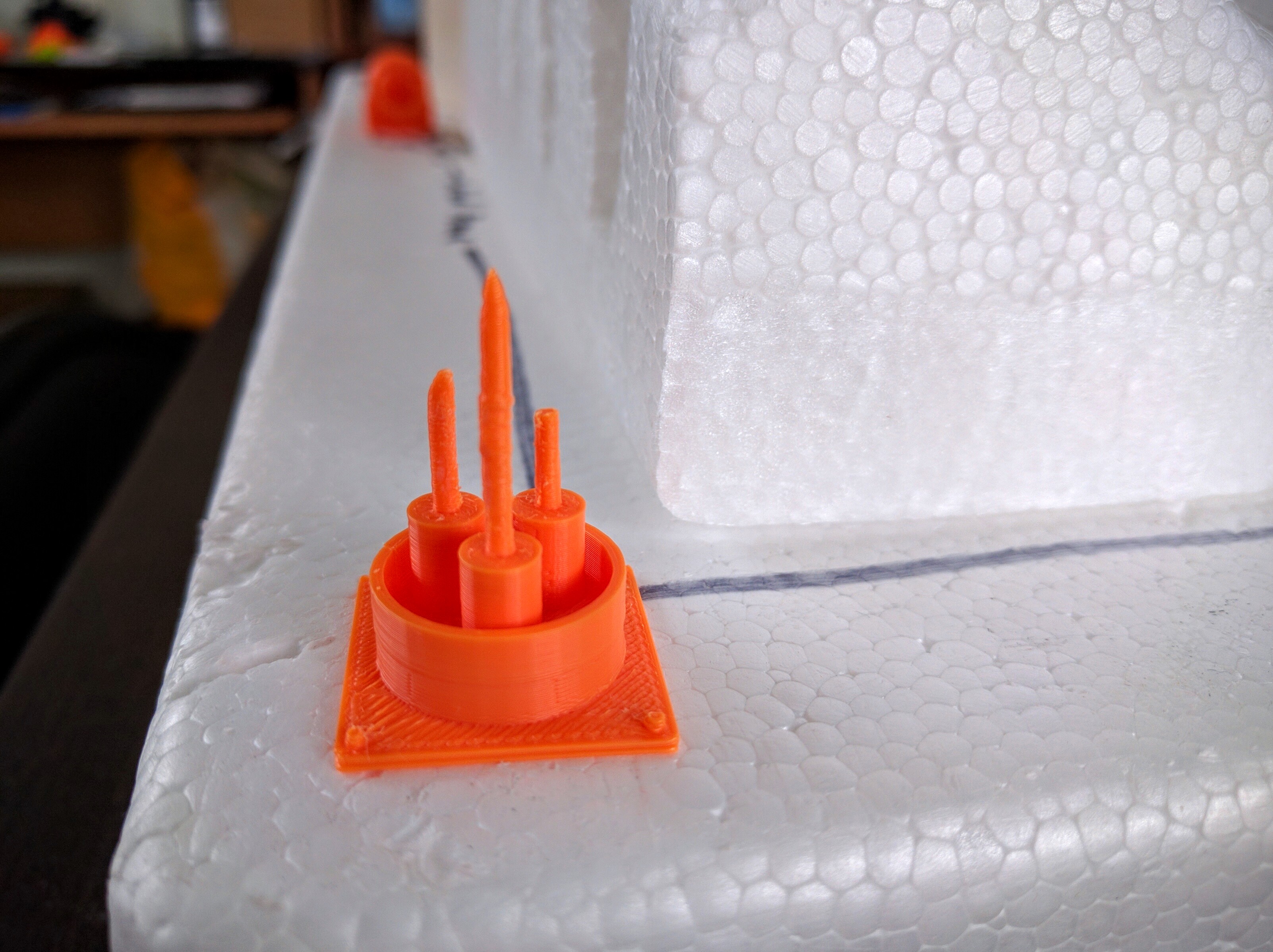
The printed antenna array.

The printed antenna array.

How workable printed parts are depends a lot on material. I’ve been using high impact polystyrene (HIPS), which is frequently used in toys. It’s very hard, not rubbery or fragile at all, but carves nicely with a hobby knife. CA (superglue) and PVA (white glue) both seem to adhere well to it. I believe ABS, a more commonly used material, would be slightly harder to cut but otherwise have similar properties.

Of course, one of the beauties of this is I can copy & paste the design a bunch of times, hit “Print,” go do something else, and a while later I’ll have a bunch more…
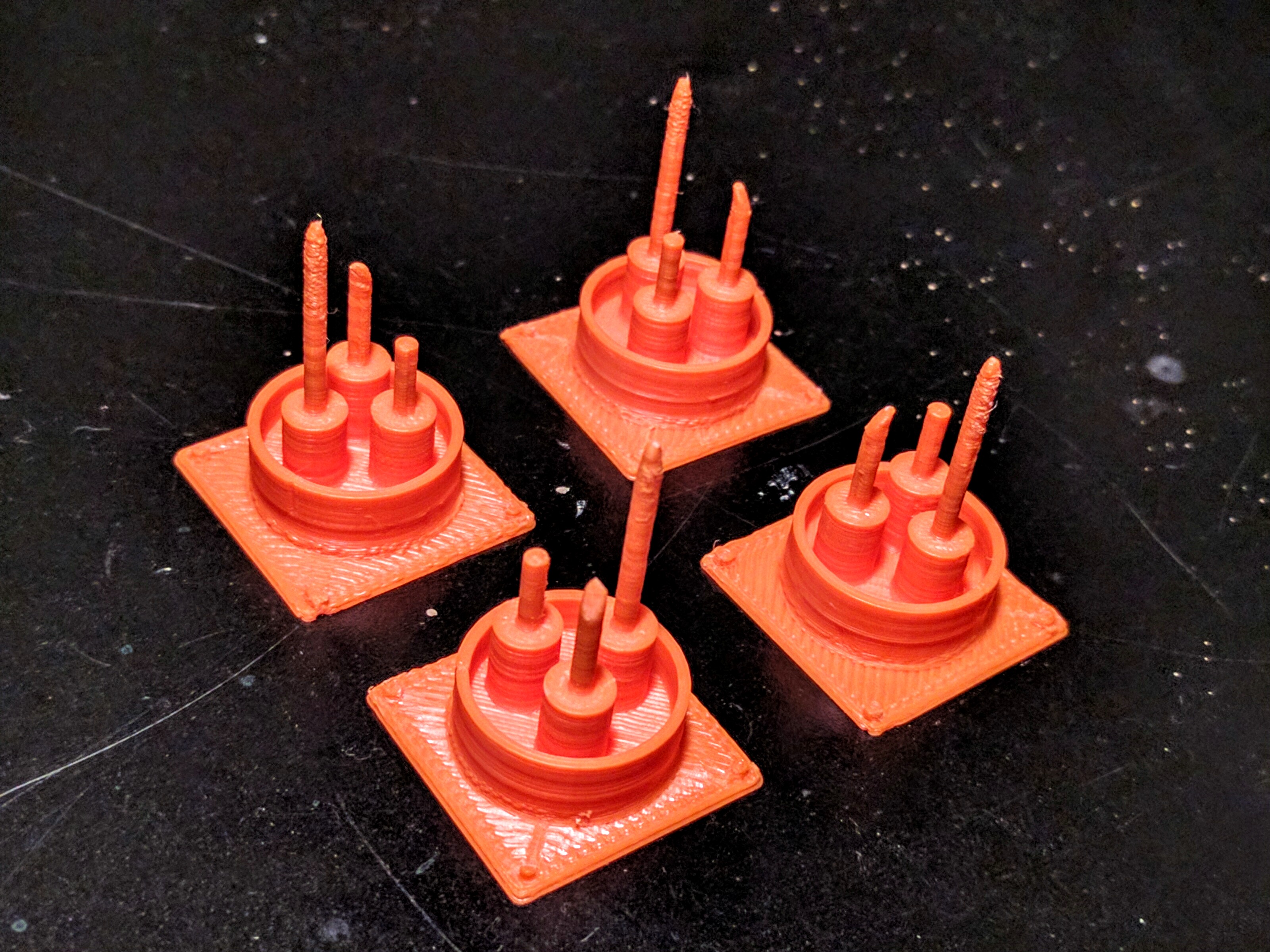
Clones!

Clones!

Conclusion

A few quick details to close out this walkthrough. My printer is a Lulzbot Mini, which I got because it met the right combination of price, resolution, and ease of use. In particular, it self-calibrates the dimensions of the workbed and cleans the print head before each run. Lulzbot maintains a version of Cura, one of the more popular open source slicing and control packages, patched with preloaded settings for their printers. Cura supports Linux and I was able to get it working under Arch Linux (not one of the directly supported distributions) with only a little fussing. The pieces shown here were printed using Lulzbot’s default “High” resolution printing, which amounts to a layer resolution of 0.18mm. Lulzbot claims the Mini can go down to .05mm resolution, but I have not played with that. I’ve been using HIPS filament, which I think is recommended for the Mini and toys & games.

The model for this antenna array is now freely available on Thingiverse. If you use it I’d love to see pictures, and I’d be happy to answer questions!

Update

A friend of mine is a professional model maker and caster, and we’ve been having a discussion about this article that may interest people. In a comment here I show more examples of printed parts and talk about costs and other tradeoffs in 3D printing for miniatures.
Medea Refinery, WIP Part 1

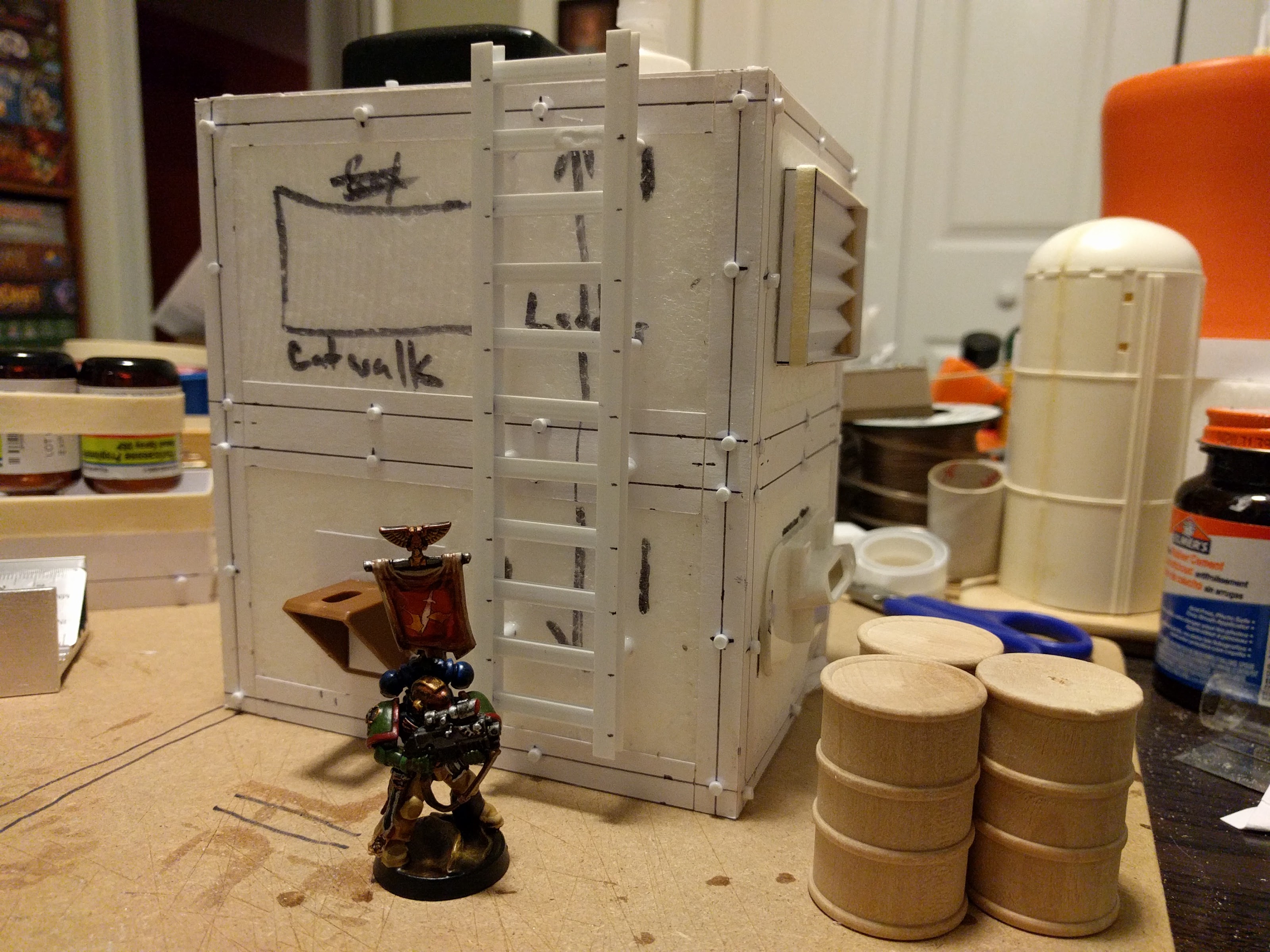
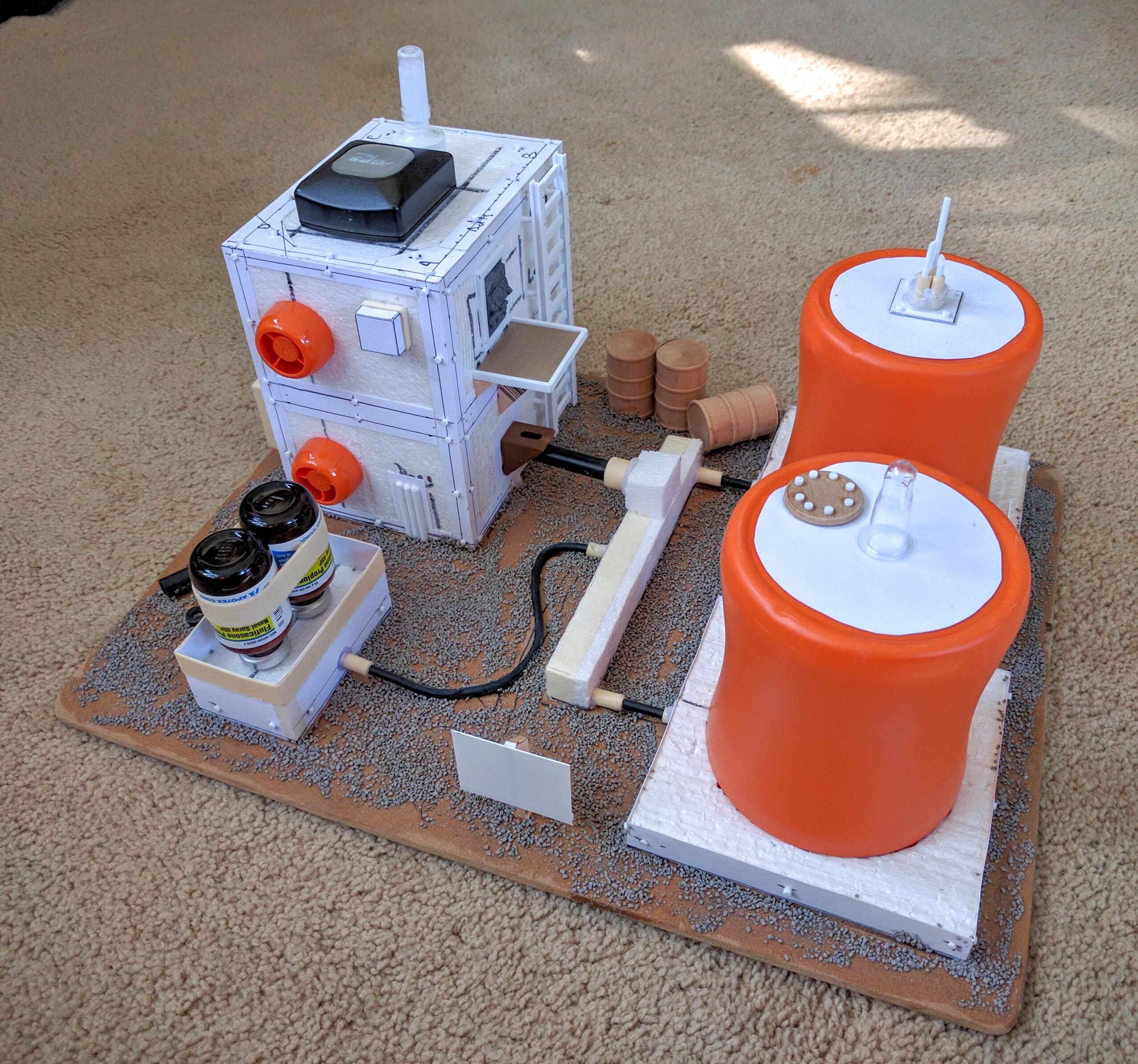
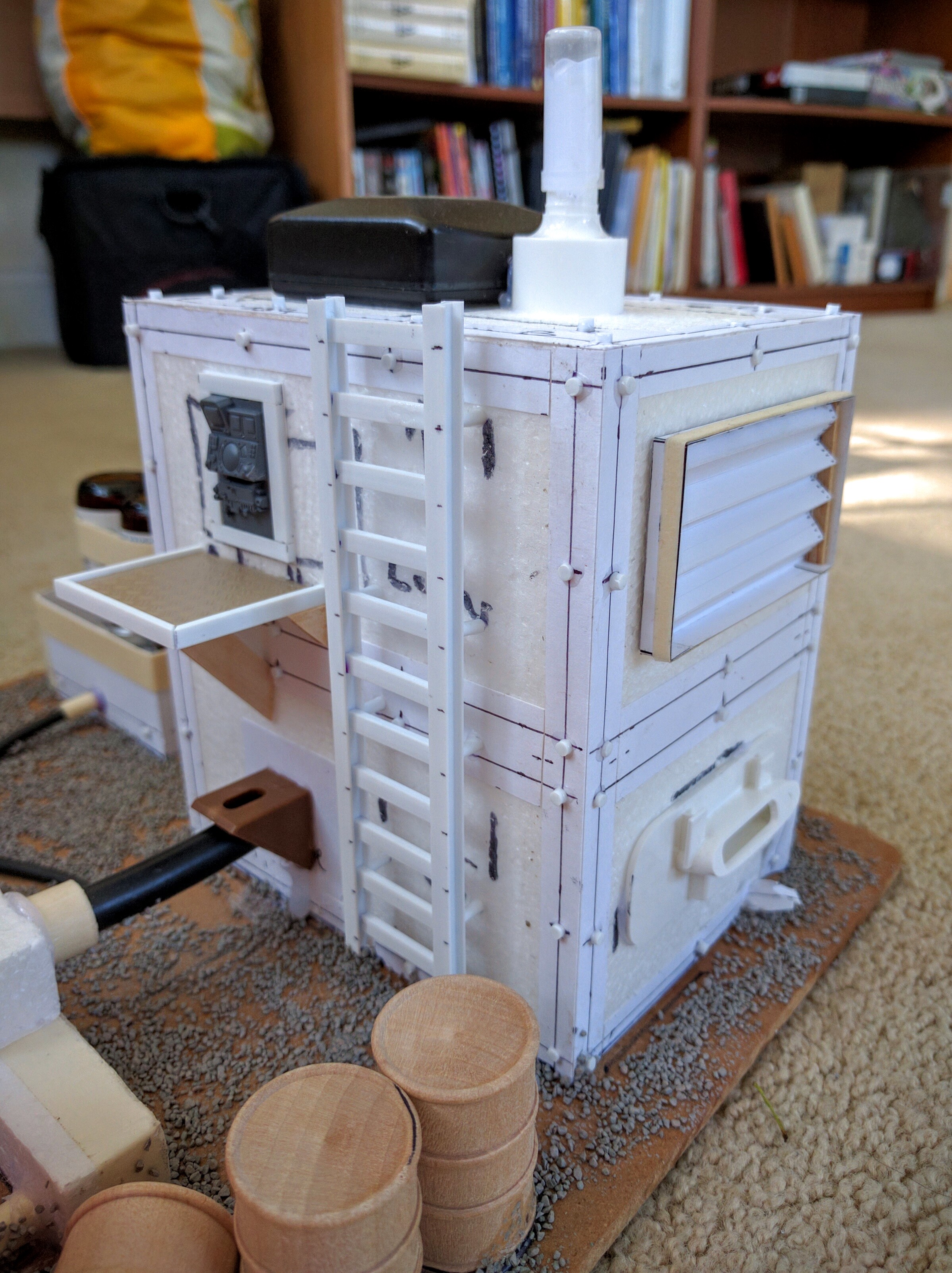
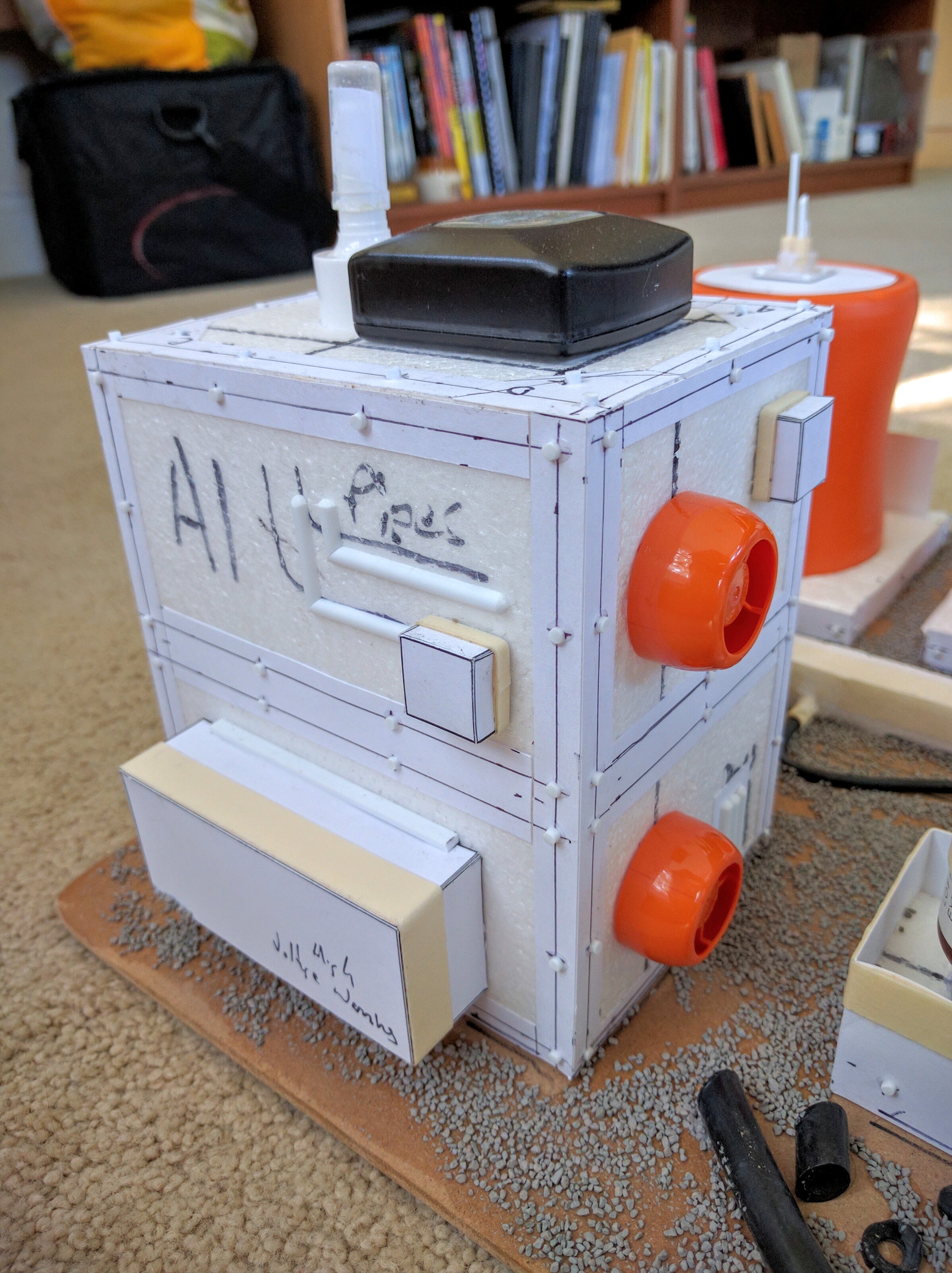
I’m working on a few new boards for our LibertyHammer event next month. First up is the Medea Refinery. I just finished building the centerpiece, Primary Pump Station A1. A detailed tutorial on building the ladder—trickier than it sounds!—is here.

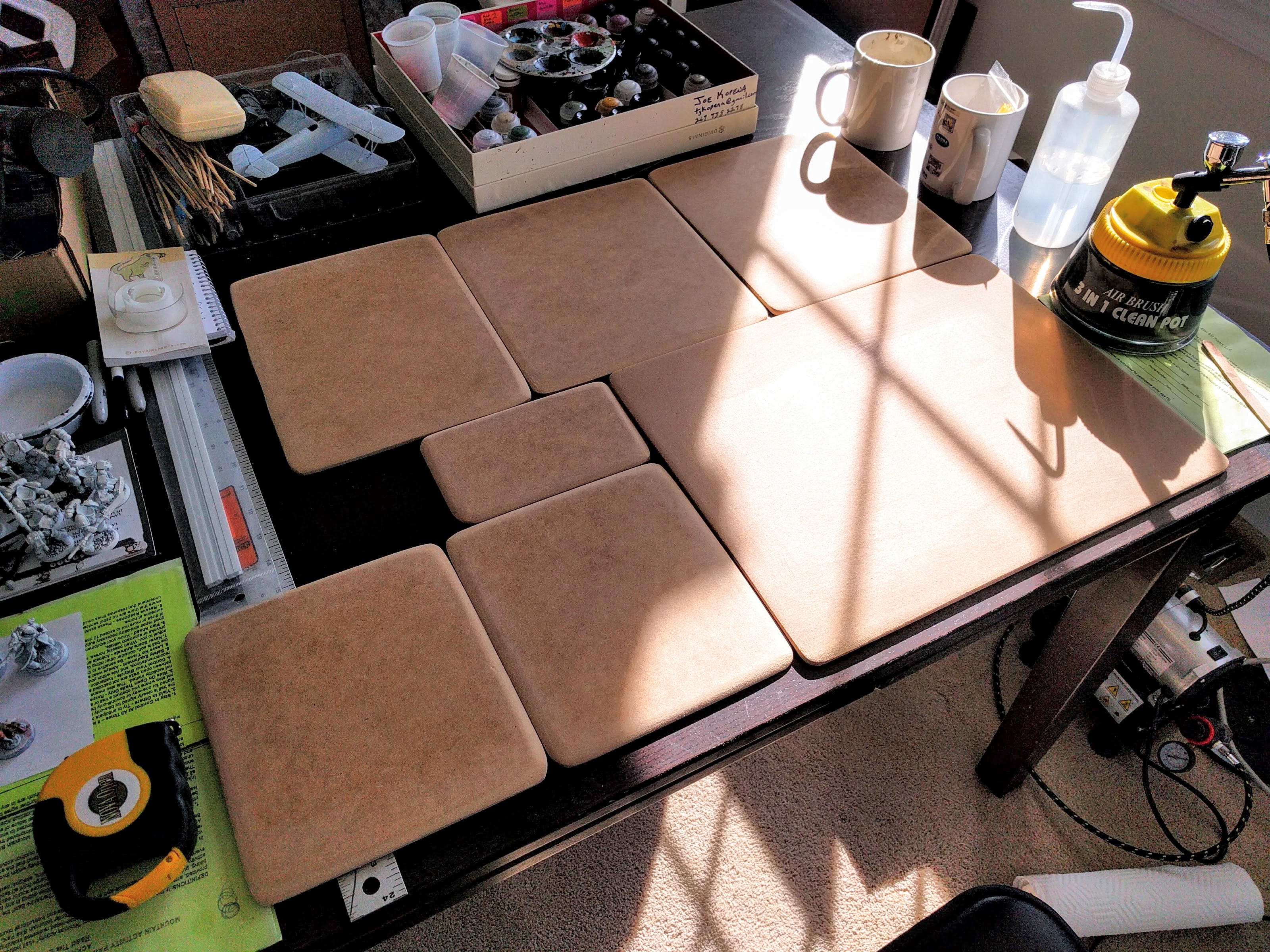
Hardboard terrain bases cut and sanded.

Hardboard terrain bases cut and sanded.

Laying out major pieces for Primary Pump Station A1.

Laying out major pieces for Primary Pump Station A1.

Building a ladder.

Building a ladder.

WIP machinery building.

WIP machinery building.

Primary Pump Station A1 all ready for paint.

Primary Pump Station A1 all ready for paint.

Machinery building details.

Machinery building details.

Machinery building details.

Machinery building details.

My tool pile at the end of this build.

My tool pile at the end of this build.

More to come!

Baby’s First 3D Printer

After years of thinking about it I finally got a 3D printer. Several models currently on the market at last hit the combo of price, print quality, and ease of use for which I’d been waiting. I haven’t done much with it yet, but so far it’s really exciting. Getting it set up and making my first print was wondrously easy, even in the somewhat obscure variant of Linux I use. Similarly, I was able to whip together a quick test part in a simple 3D modeler that was vastly quicker and more intuitive for that small job than the engineering CAD tools with which I’m familiar, and browser based to boot.

Some test parts. What's up, Rocktopus?

Some test parts. What’s up, Rocktopus?

I have just three thoughts to share while I listen to the servos on another print.

Magic

One is just a reflection on the shocking banality of magic. This is a magical device. And yet it sits on my desk, at home. The whole process is magic:

  • I order a very complex assemblage of electronics;
  • Not 24 hours later it’s delivered to my door, at no shipping cost;
  • I go back online and find some crazy mini-sculpture on a lark;
  • A simple tool lets me examine the model and send it to the device;
  • Minutes later I have a good quality 3D replica on my desk.

Nearly everything about that sequence is almost so easy to overlook today. Having an uncommon, advanced electrical appliance delivered almost immediately is a concept that would have been all but unfathomable to regular consumers even ten years ago, and very expensive five years ago. The whole Internet component of that process is itself such deep magic taken so trivially for granted these days. But producing a complex physical artifact is still this moment just rare enough that it highlights the heights of sorcery which we have brought into our everyday lives.

Just, you know, surfin' around, lookin' for some demon knight sculptures to turn into physical artifacts. Typical Thursday.

Just, you know, surfin’ around, lookin’ for some demon knight sculptures to turn into physical artifacts. Typical Thursday.

I saw my first 3D printer some seventeen years ago. As a college freshman, already working in two research labs, I tagged along on a trip to a conference on solid modeling. One of the corporate vendors in the exhibit hall was demoing a 3D printer for rapid prototyping in mechanical design. Some of the features are still not that common: It had two extruder heads, so they had a great demo wherein they printed an enclosed gearbox as one solid piece using two materials, dunked the piece in solvent to dissolve one of them, and produced a functional, intricate mechanical drivetrain that would be near impossible to build out of separate components.

At the time that demo was amazing, science fiction. But today, you can readily buy that kind of dual-head capability for home use. My printer does not have two heads, but I could buy or make an upgrade to do so. And it’s likely that the resolution on mine is as good or better as on that extremely expensive machine I saw then.

Sometimes it’s surprisingly difficult to see technological progress, either because it’s invisible or actually hasn’t happened. Just to pick two examples: It’s difficult for most people to really appreciate the improvements in automotive technology that actually have been made, as the real developments are all literally under the hood and body and mostly show up in absentia, via dramatic reductions in fatalities and pollution. Meanwhile, a true lack of progress, much of America still has barely better Internet access than it had when I was growing up on dial-up.

But this device is concrete and tangible progress you can put on your desk. Over just the course of my adult life so far, less than two decades, 3D printing has advanced from a technology just starting to transition beyond a research concept, to one rapidly becoming a household commodity appliance.

An exemplar of one of the world's most advanced technologies! ... being used here to print a literal tower of skulls for next month's boardgaming ...

An exemplar of one of the world’s most advanced technologies! … being used here to print a literal tower of skulls for next month’s boardgaming …

Science

My second thought is that, of course, this has happened before. One of my very earliest memories is the soft blue console glow from the Commodore 64 that my dad put in my bedroom as a very young kid. There has effectively never not been a computer in my life, and the profound impact that early, constant exposure and intimate familiarity has had on my career, friendships, and life is incalculable.

Demographically though I am certainly on the leading edge of the populace for which that could have been the case. Even up through to high school it was just starting, even in middle class circles among the more education-committed households, to be reasonable to assume that people had a computer at home. And yet, the middle class and up cohort born then will essentially all never have known a life without computers. Over that fifteen years or so PCs had advanced from new, somewhat obscure technology, to a near ubiquitous household item.

As a new father then, it behooves me to think—and worry—about what is next. My wife was teasing me earlier than our daughter is going to grow up thinking that everyone has a 3D printer. But that’s exactly right, everyone will. Not next year, not the year after, but absolutely by the time our baby is in high school and quite likely while she’s still in elementary school, these are going to be everywhere. Right now you can walk into several big box chain stores and pick up a 3D printer for a few hundred dollars or less. Granted, those models might not be that capable or that robust. But that’s only a question of time. This isn’t a technology that’s coming, it’s already here, already massively changing engineering and design, and poised to change business and everyday life. Being immersively fluent in 3D modeling and rapid bespoke manufacturing is going to have the same magnitude of bearing on being a scientist, engineer, or any number of other careers that computers had for my cohort. So, yes, our daughter will always have one of these around.

This interface just exudes science! ... as I print my demon knight.

This interface just exudes science! … as I print my demon knight.

Change

The follow-up question is then: What else? 3D printing, drones and autonomous vehicles, massively capable AI, ubiquitous gene hacking, these are all coming, probably in that order. “When?” is inarguably a matter of huge uncertainly, but almost certainly well within the timeframe in which I need to worry about putting my baby ahead of those waves reshaping the world.

Fortunately I am professionally and personally disposed to be fluent and comfortable with most of those. But gene hacking? I only know the most rudimentary, textbook aspects. More troublingly, what else am I missing, what imminent paradigm change is not on my radar? Once upon a time and still ongoing, computers changed everything. An awful lot of people didn’t see that coming. But now there are upheavals looming not just in practical work and daily living, but basic conceptions of production, privacy, creativity, science, and even personhood. How to prepare a little person for an onslaught of change that will be deeper and faster than anything to come before, and will likely only get deeper and faster?

That prospect should be scary. In many regards it is terribly so. Humanity as a gestalt is tragically unprepared to harness and manage these disruptions.

On an individual level though, the true fundamentals will remain so even as the world qualitatively changes. Direct familiarity with the tools will always matter, and it’s grossly unfortunate that inequality in access seems poised to only grow with time. But humanity’s ultimate toolset will always be the same: Critical thinking, curiosity, empathy, our intelligence and values. Just as determinative as my newfangled home computer to my comparative success navigating the information age were much more time-honored assets: The shelf of encyclopedias and dictionaries we had within kid-reach, and the weekly trips with mom to the library, hauling home stacks of Encyclopedia Brown, Star Trek, and Shakespeare.

So, this afternoon, baby and I will probably play with the 3D printer just a little bit. It is, after all, a pretty cool robot. But then, just like most days, we’ll read our increasingly tattered copy of Where’s Hedgehog?, crawl around exploring under the tables, and give big hugs to Zebra-Giraffe and all our animal buddies. Because, just as they have always been, these are the root skills, traits, and values I can give her that are going to help her through even the changes to come that I cannot possibly foresee. Thinking, curiosity, empathy. In the end that’s all there is under everything, no matter what new and magical forms the world takes.

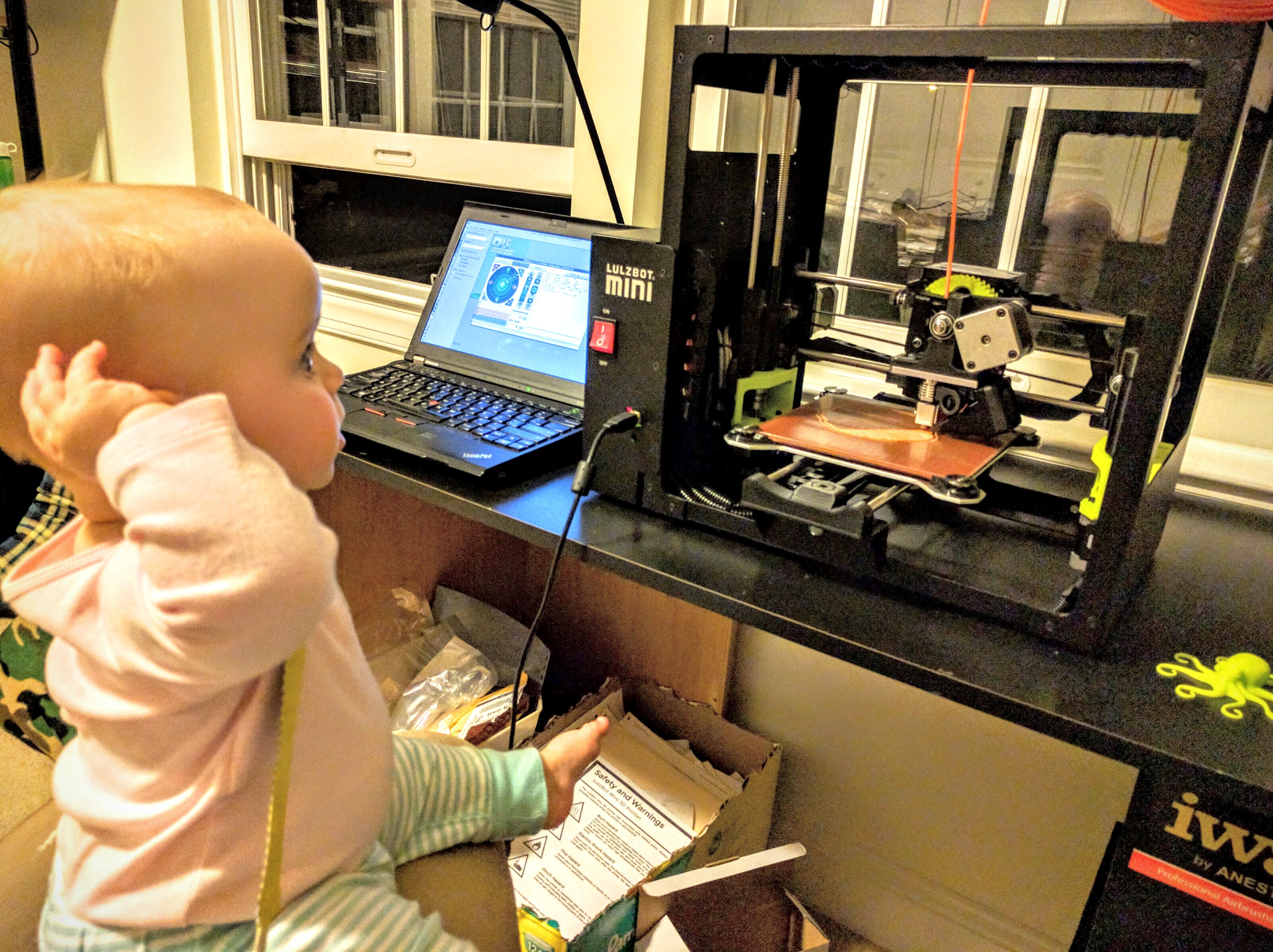
Baby's first 3D printer.

Baby’s first 3D printer.