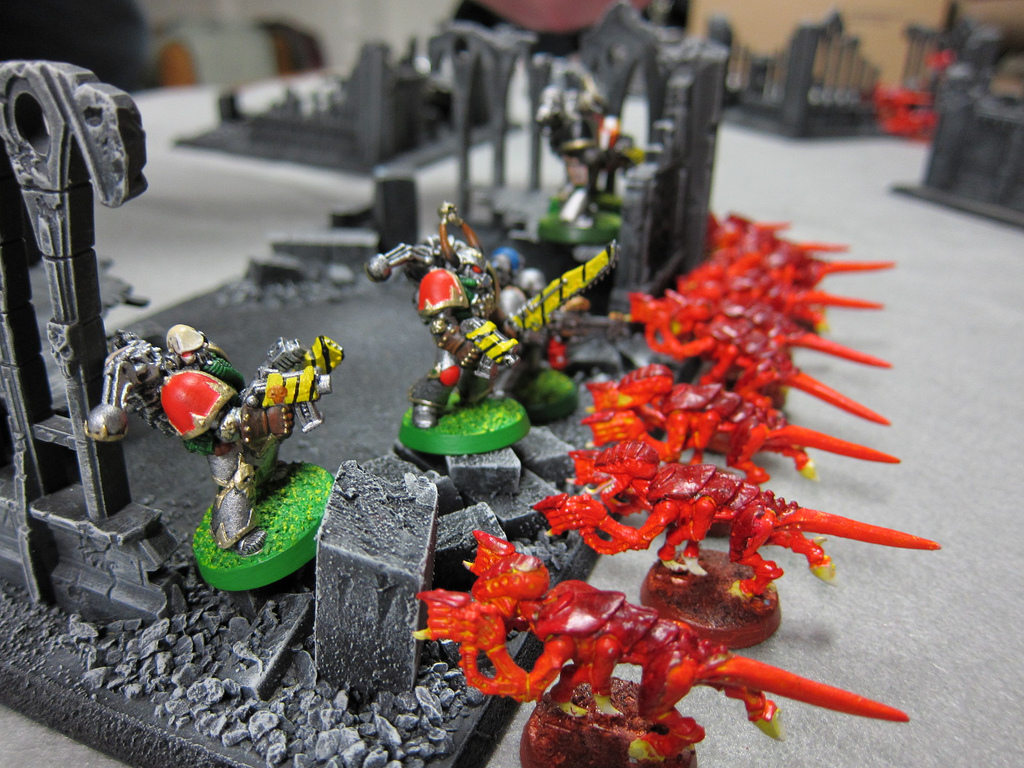
 Recently, Pangloss and Equinox have been having a pretty good discussion about Combat Patrol in 5th Edition:
In an earlier post I talked a bit about some of the reasons I like Combat Patrol, namely accessibility, faster games, and reduced rock-paper-scissors effects, which can be dramatic in low points games. I’ve also talked a bit in the past about general issues in small 40k games. I thought I’d add on to my earlier points with some more thoughts on revising the rules to better accommodate the current codexes and rules.
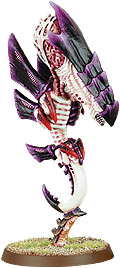
The Zoanthrope says: "You best get good at rolling Leadership Tests!"
As a case in point for why revisions are necessary, consider the new Tyranid codex. Due to the restrictions to 2 Wounds and 4+ Invulnerable saves, there are no Synapse Creatures permitted in Combat Patrol under the new book. For those unaware, without coverage from Synapse, almost every Tyranid unit has to pass a Leadership check. Otherwise it either storms toward the enemy or hides. That severely hampers playing the new book in Combat Patrol, unless you field purely hordes of Genestealers, who are not subject to Synapse, but have no ranged weapons. That also gets a little boring after a while. This essentially eliminates a very popular army from playing, a substantial problem.
Points Limits
I agree that 750pts is pushing the upper bound for Combat Patrol; beyond that it’s too constricting and should generally be played as a standard game. But I think a good set of rules could work well over ~250–750 pts, and create a game atmosphere that feels different from standard 40k but is similar enough to just sit down and go. Like Equinox said, that’s an important goal.
A major determinant in what points levels work depends on what armies are used. A friend and I regularly play 250pts. That’s probably the lower bound without true skirmish rules, but we have fun though pushing models around at lunchtime. It works because he’s running Chaos Marines and I run Space Marines, and that’s just enough points to both have some choices and field some variety. Other armies really struggle at even 400pts; Necrons are the classic example, Grey Knights are another. Viable points levels depends a lot on who’s playing.
I think the set points clearly depends on what people what to get out of it, and there isn’t a need to be too strict about what is “Combat Patrol” and what’s not. For example, one reason we’re running 750pts in our tournament is because it allows a good number of units, which in turn enables more varied mission scenarios. At 400pts a lot of armies basically field only two units, so it’d be hard to have objectives and other special scenario goals. Asymmetric scenarios, played with alternating roles, were also something we liked the sound of. But, we also wanted people to be able to play after work. The 750pt limit supports those competing goals, while also being a slightly longer match than 400pts. We have, however, applied the Combat Patrol rules rather than just limiting the points, largely in order to prevent rock-paper-scissors list making issues. Similarly, 400pts is very fast to play, very accessible, and a lot of fun in its own right. There’s clearly a place for both.
HQs
A great number of HQ units definitely seem potentially unbalanced at these point levels, or not in the spirit of the missions if you care about that sort of thing. I think you can keep out “crazy” HQs by keeping some sort of restriction against uniques, but let in the “regular” HQs by drifting the allowable wounds up to 3. That enables IG Company Commanders, Tyranid Warriors, Space Marine Captains, etc., all of which are reasonable to me, but cuts out Abaddon, Marneus, etc., whom I think present problems. More on “Uniques” later.
"Outflanked again, Sgt Jericho? This never would have happened if Captain Angholan had been permitted to join the patrol!"
In any case though, I don’t think HQs should be required. Too many are glass jaws to force them at this point level. For example, a Space Marine Captain is actually a tough sell. I wouldn’t say that they really bring in their 100+ pts on average; ditto Librarians—sometimes they come up huge, but a lot of times they don’t. Chaplains also essentially force a unit to lose Combat Tactics, which is unfortunate. All are solid selections in a full list with other units to synergize with and many other models on the table, but I wouldn’t want to be forced to take one with so few points available. Conversely, I wouldn’t want them disallowed either. For this week’s tournament mission, I would have strongly considered a Captain and Command Squad—the first time I’ve ever seriously thought of the latter—but the Captain is out due to the traditional 2 wounds restriction.
Heavy Supports
In my opinion, Armor Value restrictions keep out sufficient HS. I wouldn’t ban HS completely and eliminate Devastators or Havocs, they don’t seem out of line for the feel of the game.
I also don’t see the traditional restriction against Ordnance as being necessary. If someone wants to field a Basilisk, Predator, Whirlwind, or something, I’d be ok with it, and think it’s reasonably fluffy—a lone vehicle making its way to a new position with its escort or some such. Especially on a smaller table, they’ll be prone to assault or concentrated attack, and the armor value on this units is not particularly higher than the transports; I don’t think they’d be dominating choices.
At 750pts I’d actually lift the armor restriction a bit, maybe to 34 total points rather than 33. In that size army you can field enough options to have some reasonable anti-vehicle plan, and could work to take down more heavily armored vehicles. I would probably not say this at 400pts though; the environment is just very different. In particular, my experience has been that Dreadnoughts are devastating and frequently unstoppable at that point level.
Either way, even at 750pts I’d hesitate to let in a Land Raider, Monolith, or similar vehicle. It’s true that they would be a huge points risk that might be taken out relatively easily—I’ve had Sternguard take out even an entire Baneblade by themselves in the first round of shooting, and Landspeeders can regularly do the same for Land Raiders. But I think these are just too much of a rock-paper-scissors risk at these point levels for my taste. Those also have accessibility issues for newer players trying to compete.
One idea that came up in our group is to have a total limit for the army. Something like you can field any vehicles, but the combined armor across all of them must be less than 100 (or something). That would let you use one or two big vehicles, or a couple smaller vehicles, or a mix. It might be just as easy though to say “One vehicle with armor up to 34 (or 35, etc) and any number with armor up to 33.”
Elites and Fast Attack
Tight limits on FA and Elites are also problematic. I think a squad of Sternguard and a couple Landspeeders is fairly fluffy for combat patrol. Landspeeders, Rough Riders, and Sentinels all also provide for all-FA lists very much in keeping with the spirit of Combat Patrol. Appropriate mission rules probably counter any problems here. In our tournament, you could bring a ton of Elites, FA, etc., but many of the missions have objectives, so it behooves you to bring Troops, just like standard 40k.
General Unit Restrictions
Like Pangloss said, I also think Equinox’s proposed 200pt maximum per unit restriction is too tough, although the intent is good. As noted, a squad of Marines is 170pts. Add a Rhino or a Powerfist and a Plasmagun and they’re over that limit. The problem with saying they can just take five man squads is then they don’t have access to heavy and special weapons. Cheap weapons are one of the primary advantages for Space Marines compared to many races, and their main anti-horde and anti-vehicle counter abilities, so robbing them of that would really hinder them unfairly.
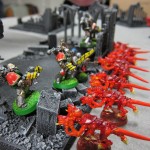
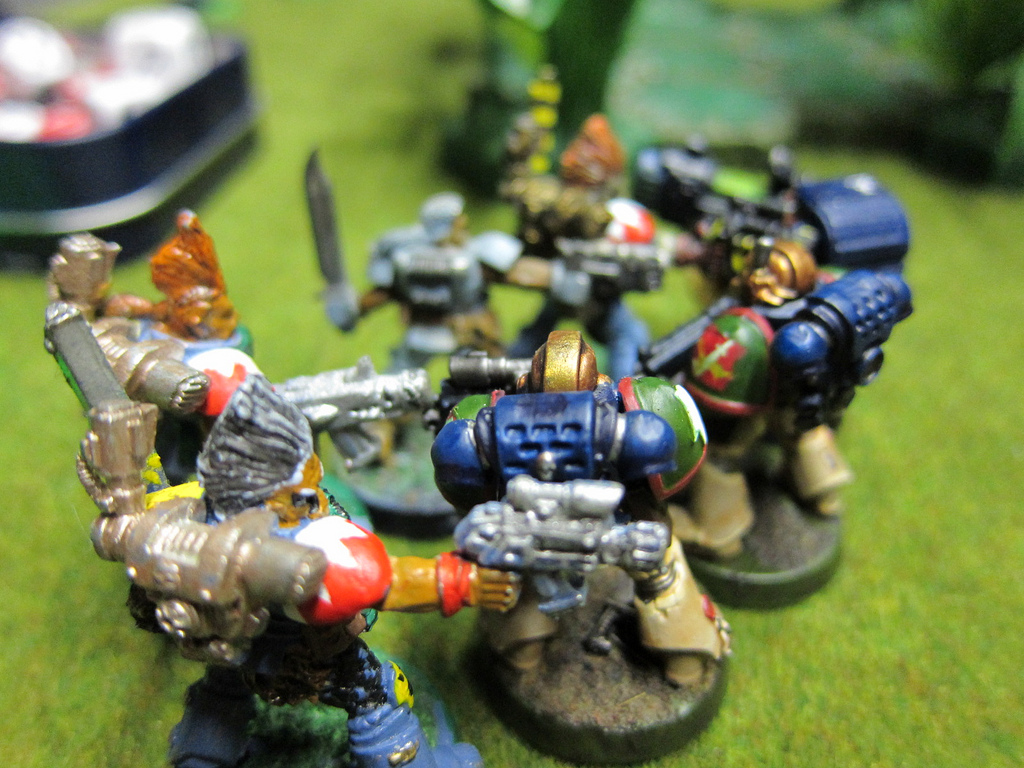
These Termagants haven't realized yet that they're supposed to be Lurking...
Lifting the permitted wounds to 3 is essentially required, if only to enable Tyranids a few viable Synapse Creatures. It also permits the generic Space Marine Captains and Chapter Masters (and consequently Command Squads), IG Company Commanders, and many other units that don’t seem unreasonable.
Not discussed so far is if the traditional Combat Patrol restriction to no better than 3+/4+ saves should be relaxed. I am torn on this. One argument I see for relaxing it are Zoanthropes, an important Synapse Creature option for Tyranids. However, if permitted wounds are bumped up—basically a requirement, I think—Tyranid players can cover Synapse via at least Warriors. I also don’t see a reason to cut out Techmarines. However, I have mixed feelings about Terminators. They’re admittedly super hard to take down and could cleave through another army, but even at 750pts they would be a significant fraction of a list to invest in just a few models. They also don’t generally score, so the mission scenarios will enforce some sort of natural balance. Including them would also enable Dark Angels players to use their preferred codex and existing units. One plausible option might be to allow 2+ armor saves, or 3+ invulnerables, but not both. This would permit Zoanthropes, Captains in Artificier Armor, Honor Guards, Techmarines, etc., but not Terminators.
Similar to Equinox, I also don’t have issues with upgrade characters like Telion or Harker. They just don’t seem that unbalancing; they’re useful, but they’re a bunch of points as well. The key here is the wording, enabling these guys but keeping out crazy HQs. Toward that end, I think the wording should be “No Unique Independent Characters, Unique Monstrous Creatures, or Special Characters.” The rationale behind this specific wording is based on:
- Space Marines: Telion does not technically say Unique (he has a special rule limiting him to 1 squad), but Chronus does; neither are Independent Characters. The fancy HQ characters are of course all Unique Independent Characters.
- Chaos Marines: All named characters are Unique Independent Characters.
- Orks: Snikrot and Zagstruk are not Independent Character, nor technically Unique, and hence would be allowed. The few named HQs are Unique Independent Characters.
- Tau: Aun’va, Farsight, and Shadowsun use the old terminology and are listed as Special Characters, not as Uniques.
- IG: Yarrick is a Unique Independent Character; all the company commander characters and other upgrades are Unique, but not Independent Characters. Marbo is also Unique Infantry and would be allowed.
- Chaos Demons: All the named demons are Unique Monstrous Creatures, not Independent Characters. Interestingly, Fateweaver is a Unique Monstrous Creature with only 3 wounds so it would not otherwise be covered by the rules without this wording.
- Tyranid: Most of the named characters are Unique Monstrous Creatures, though Parasite of Mortex is Unique Jump Infantry and Deathleaper is Unique Infantry and would be allowed.
I think that wording strikes a reasonable balance, permitting these manageable, colorful upgrade characters and a few solos, but disallowing the real heavies.
Rules Suggestions
That makes my current thinking on revised Combat Patrol rules something like:
- Missions should set army lists at no more than 250–750 points.
- Armies must include 1 Troop unit and may have up to 2 HQ, 6 Troop, 2 Elite, 2 Fast Attack, and 2 Heavy Support units.
- No Unique Independent Characters, Unique Monstrous Creatures, or Special Characters are permitted.
- No model may have more than 3 wounds.
- Any model with a 2+ Armor Save may not have an Invulnerable save.
- Any model with a 3+ Armor Save may not have better than a 4+ Invulnerable Save.
- In a 500pt or below game, no vehicle may have total armor value (Front+Side+Rear) greater than 33.
- In a 501–750pt game, no vehicle may have total armor value (Front+Side+Rear) greater than 34.
- Units which don’t occupy Force Organization slots, such as Dedicated Transports and Retinues, are permitted caveat the other rules.
- Before deployment, each player must declare one model in their army to be their Patrol Leader. There must not be a model in the army with a higher Leadership value. Note that this implies the Patrol Leader is not a vehicle.
- Missions should be played on 4’x4′ tables.
The Patrol Leader isn’t important for standard mission setups, but I think it’s a handy designation to have in writing custom scenarios given that there’s not necessarily an HQ in each list. For example, in our tournament preserving or killing Patrol Leaders has been worth Bonus Points on several occasions.
Glancing through the codexes I have and the main rulebook, these rules seem to disallow the following for 750pt games; in general, no named characters are permitted except as discussed above regarding “Uniques”:
- Orks: No Battlewagons.
- Chaos Marines: No Terminators, Oblits, Daemon Princes, Greater Demons, or Land Raider variants.
- Chaos Demons: No Bloodthirsters, or Soul Grinders.
- Daemonhunters: No Grand Masters, Brother Captains, Terminators, or Land Raider variants.
- Tau: Broadsides, Crisis Shas’O Commander, Hammerheads, or Sky Rays.
- Black Templars: No Emperor’s Champions, Terminators, Land Raider variants.
- Space Marines: No Drop Pods, Terminators, or Land Raider variants.
- Necrons: No Wraiths, or Monoliths.
- Imperial Guard: No Leman Russ variants.
- Tyranids: No Swarmlord, Hive Tyrants, Tervigons, Zoanthropes (3+ Inv), Doom of Malantai, Carnifexes, Old One Eye, Trygons, Mawlocs, or Tyrannofexes
Dropping the permitted vehicle armor values to 33 at 500pts further eliminates:
- Orks: No Deff Dreads.
- Chaos Marines: No Predators, Vindicators, Defilers, or Dreadnoughts.
- Space Marines and other Imperials: No Dreadnoughts, Predators, Vindicators, or Dreadnoughts.
- Imperial Guard: No Hellhound variants, Death Strikes, Valkyries or Vendettas,
Those rules also eliminate some wargear and combinations, such as Storm Shields combined with Artificer Armor. Interestingly, Mycetic Spores have only 3 wounds and a 4+ save, so Tyranids would always have their Drop Pod. For Synapse they would be able to choose from Tyranid Primes, the Parasite of Mortex, and Zoanthropes.
Conclusion
I had sort of thought the forthcoming 40k Missions Book from GW would have material along these lines, including revised Kill Team or Combat Patrol rules and missions. The part of me that refuses to accept that they don’t playtest or think about a lot of their design products nearly as much as the community does was actually hoping for that. However, that doesn’t seem to be the case.
Of the suggested rules above, I feel pretty comfortable with the vehicle restrictions. The armor and invulnerable save restrictions however might be too permissive however. I’ll have to think about them more. As always, comments are welcome!
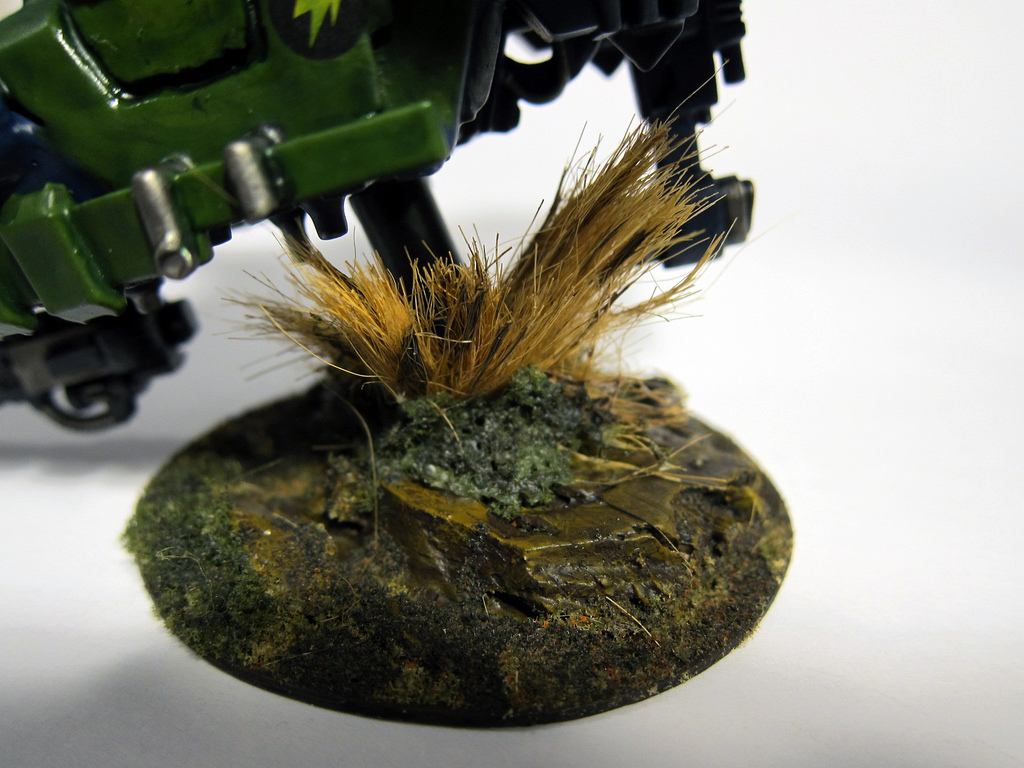
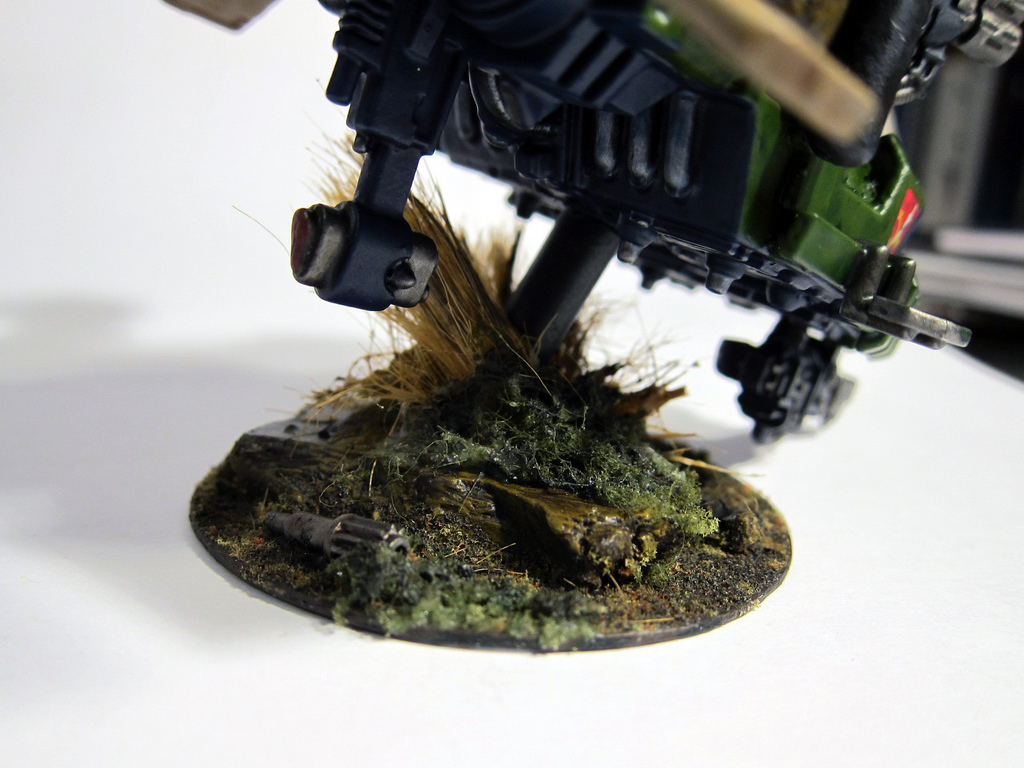
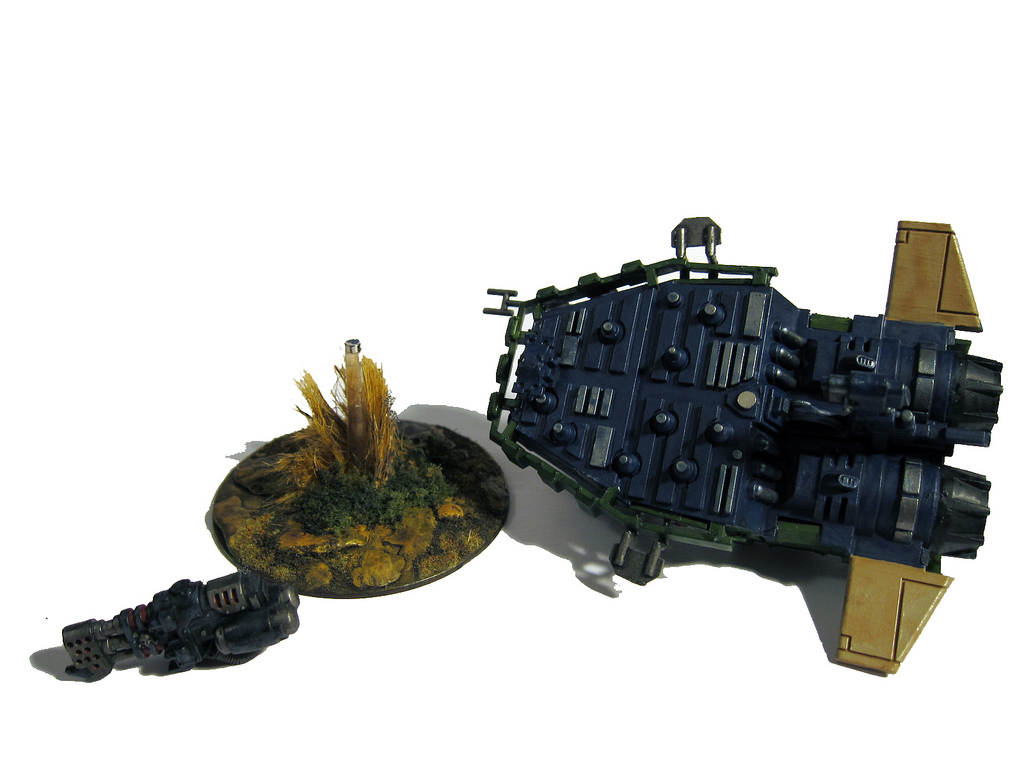
 Some time ago, my buddy Matt gave me a half-complete conversion project. He’d taken a Landspeeder, cut up the cab, and added some bedrolls, smoke launchers, and a Storm Bolter type thing on an extra wing frame. His aim was to build some sort of IG recon vehicle, but he decided it wasn’t going anywhere and handed it over.


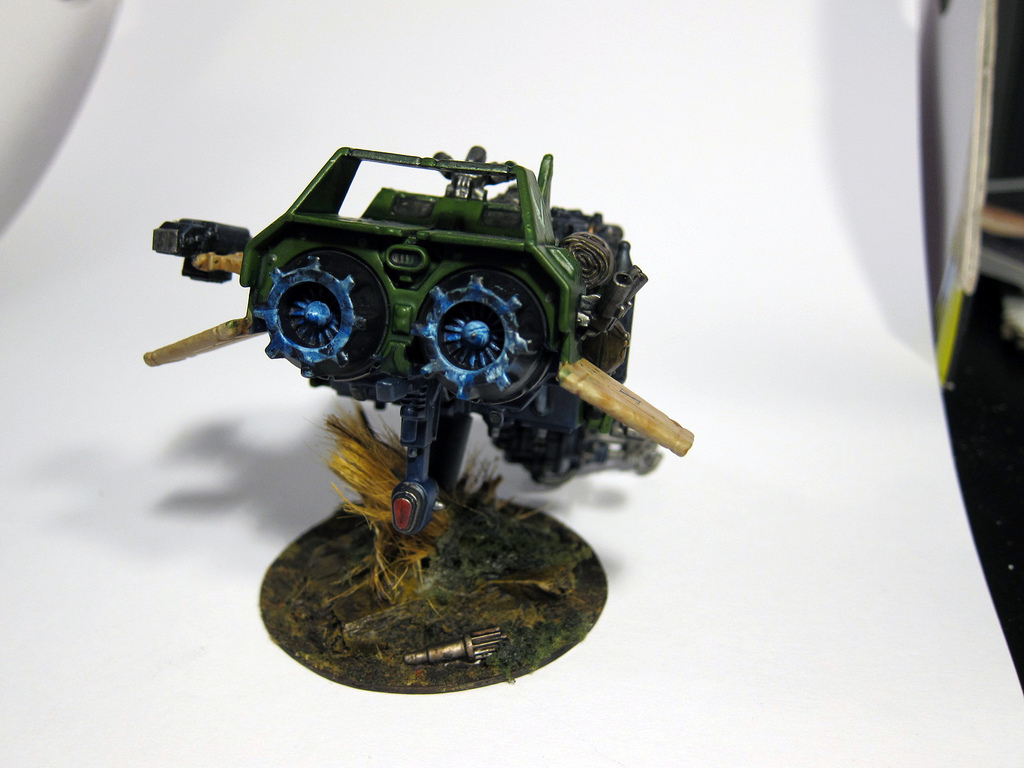

 On the construction side of things, I like the Landspeeder models a lot as they’re fairly straightforward to assemble, and quick to paint. Between these two I didn’t find a huge difference in painting before versus after assembly, but would probably do the former in the future. Really the slowest parts are the two Marine pilots, but they’re not too bad if done before assembly. The Kingbreakers icons are done with custom decals I made up. Like all my vehicles, these were base coated with cheap black spray paint. The main paint components in the Kingbreakers’ scheme are Privateer Press Paints’ Hammerfall Khaki, Ordic Olive, and Exile Blue, respectively washed with GW Gryphon Sepia, Thraka Green, and Asurmen Blue. The washes highlight the shapes of the components and provide a little bit of a weathered look I like, with basically no effort. I’ve found so far that really edging the lines on vehicles takes a ton of time and doesn’t really stand out on the gaming table, so for both these models I skipped that step in favor of getting them done.