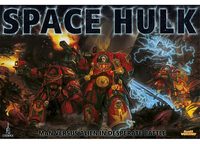
 Jason and I got to play two rounds of the new Space Hulk yesterday, alternating sides on the short first mission. For all the hype on the Internet about that mission being a suicide run for the Marines, clearly those people just need to find some better Sergeants…
The first thing to notice is that the whole game is awesomely put together. Not only are the minis out of control, but so are all the pieces. Tiles and chits are made of super thick cardstock, much beefier and sturdier than any boardgame pieces I’ve ever seen before. To top it off, the tiles are embossed in places to give them a noticeable 3D effect. Some of the art is not super compelling, such as the Jammed chits, but the corridors and doors look absolutely amazing. The miniatures, if anything, are too dramatic and overly done. Space Hulk Terminators will outshine most regular Terminators if used in a normal 40k game, they’re easily as ornate or more so than most captains and generally more dynamic. Some people may also consider the Genestealers too over the top. The poses are solid and varied, but the ornate debri bases look somewhat out of place outside a diorama and definitely won’t work well for use in normal 40k. All in all though, these are finding fault in near perfection. These miniatures are glorious, sturdy, clean, and awesome. That said, the only real downside of the pieces is that the board tiles should be a bit larger to accommodate the very dramatic, large poses of the Marines and Tyranids.
Next to observe is that this edition is basically a very lavish reprint of the previous versions, for better or worse. The missions and maps are largely identical to those of the first and second editions. Core rules are almost exactly the same as those for the first edition, with a few tweaks such as minor differences in Action Point costs, jamming being less lethal, the new Guard close combat Overwatch variant. By extension this makes the game also very similar to the second edition, but probably more nuanced and interesting, in particular as the use of Command Points is more strategic than in second edition as they may be used in the Genestealers’ turn. A few additions have been made from the first edition expansions, such as the autocannon, Broodlord, and Librarian, but they’re all fairly simple and seem straightforward. All of the rules and elements seem very straightforward and fast playing once you have a handle on them.
That said, the rulebook is not well done and getting a handle on everything, while not complex, seems error prone and interpretations will likely vary from gaming group to gaming group. The book is lavishly produced but in classic GW fashion omits a large raft of assumptions and contains many ambiguities. This is unfortunate because it really mars an otherwise stellar product. Just a little extra work reviewing the rulebook could have saved so much hassle and frustration, and I highly doubt they would have even had to pay anyone to do it. In point of fact, people probably would have paid to help beta test and uncover these problems… GW’s development style and apparent refusal to simply work with some outside playtesters or bring in good editors and a review team continues to boggle the mind.
Overlooking those issues, in terms of play, things are largely the same as they were in the first edition. That’s both good and bad. In some ways similar dungeon crawls such as Doom are much more tactical and rich, with more movement, weapons, awesome ammo systems, and other neat features. On the other hand, Space Hulk remains a fast playing, simple but intense experience and its narrative experience remains well above par. In particular, the detail and dynamic poses of the Marines makes them highly identifiable; they’re even clearly named in the mission book. This adds even more to the drama than in previous editions. No longer is it just some Terminator holding down a corridor. Now it’s Brother Noctis, his back to the wall, aliens chittering in the darkness, staunchly standing his ground to preserve the team’s rearguard and any hope of an exit route as the rest of the squad dashes toward the objectives. This kind of narrative is really the star of the game and critical to really enjoying it, though it’s a solid game regardless.
In that vein, I think it’s important to approach the game as slightly less of a tactical combat game, and slightly more of an abstract resource management game. In many respects the key decisions aren’t about maneuvering models around each other and optimizing fire sequences—you can’t, the corridors are too tight—but rather about conserving and expending resources as necessary. For the Marines those resources are men and Command Points. Resources for the Genestealers are aliens, uncertainty, chokepoints, and the distance between the Marines and their objectives. That’s not to say there aren’t tactical decisions and moves to be made, but the predominant real decisions are those sorts of considerations, rather than particular questions of movement or firing patterns. That’s not a bad thing at all, but a mindset that should be considered and appreciated whenever approaching your own infested hulks lurking in the chill depths of space.