Space Marine Detachments

Earlier I wrote a quick walkthrough about army list selection in Warhammer 40,000 8th edition. Unfortunately, aspects of those rules demonstrate again that 8th edition is very good, but neither as slimmed down nor formal and clean as it has been hyped to be.

The issues crop up from the new incarnation of Objective Secured, which enables models selected as part of an army detachment with uniform faction to trump other models for control of objective markers.
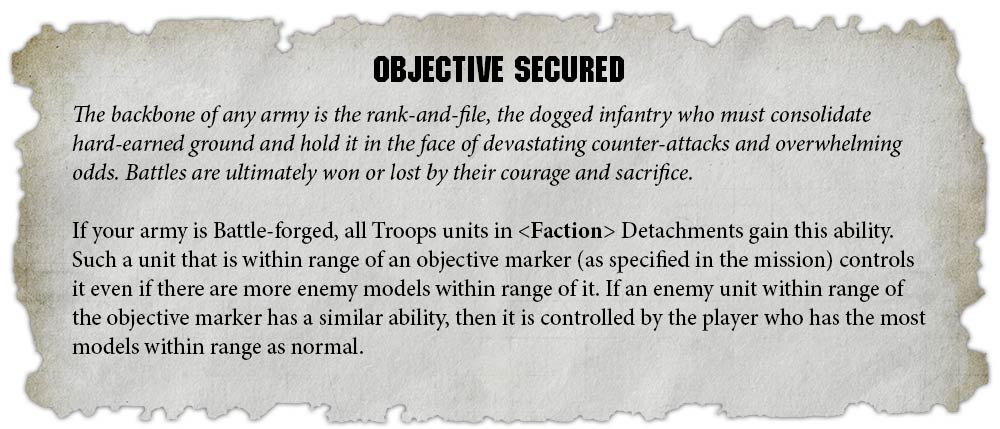
Preview of Objective Secured rule from the upcoming Chapter Approved.

Copy & Paste

To begin, there isn’t really a rule for Objective Secured. There’s a rule for Objective Secured, Defenders of Humanity, Knights of Titan, and so on. All the different codexes are coming out with the same rule under different names, e.g., the Space Marines’ Defenders of Humanity. Meanwhile, to maintain some parity for the factions that don’t have a codex yet, GW previewed an Objective Secured rule to be included in the upcoming Chapter Approved supplement giving that ability to all of those armies.

This copying & pasting is strange and unfortunate. Defenders of Humanity made sense at first when the ability was initially presented to be a unique Space Marines advantage. The presumption was other codexes would then arrive with different but similar abilities. But it turned out they all just have the same ability. Note that the abilty per se isn’t the problem. Diversity of abilities would be interesting, but also harder to balance. It’s the presentation of this universal ability that is problematic. Even minor carve outs such as for Fabius Bile and Fallen being compatible with all the legions and thus not breaking the faction uniformity of Chaos Space Marine detachments don’t merit copy & pasting the entirety of the basic idea into each book.

To look at just one issue, because there’s no universal term, the rule concept can’t be expressed in as simple and formal a fashion as before. E.g., to paraphrase previously:

Models with Objective Secured trump models without Objective Secured for control of objective markers.

Instead the new rules have to be worded in terms of trumping models with “a similar ability” because they all have different names. What does “similar” mean? In practice it’s understandable, but it’s not as formal as it could be.

All this duplication under different names is unfortunate but a hallmark of this edition, a consequence of “streamlining” the game by eliminating common text from the core rules and main rulebook and instead pushing it out to numerous copies in the codexes and datasheets. If all the factions are going to have this rule, there should just be one straightforward universal rule. That centralization would reduce the overall volume of rules and text, foster understanding, be more formal, and prevent errors from creeping in over time with successive copying.

This is also another example of how GW went to all the trouble of introducing a keyword system, but isn’t actually using it well. Objective Secured could easily be handled more elegantly and formally by granting units keywords if their detachments meet given conditions and wording the ability around those keywords.

Ambiguity

More critically, these rules contain ambiguities in their prerequisites. For example, Defenders of Humanity relies on the definition of a “Space Marine Detachment.” The other books are structured similarly. As explained below, that definition isn’t 100% unambiguous on whether or not a Space Marine Detachment can include multiple chapters within the codex, e.g., Salamanders and Ultramarines. It is explicit that Space Wolves and the other variant codexes are not included.

Beyond Defenders of Humanity, this ambiguity also raises rules questions about stratagems. Those listed in the codex are unlocked if you field a Space Marine Detachment. So must you field a detachment drawn from a single chapter to get access? Or would a detachment comprised of any mix of Space Marines suffice?

Mixed Chapters

In defining a Space Marine Detachment, the codex provides a list of chapter keywords which a “Space Marine unit” might have and then says:

A Space Marine Detachment is therefore one which only includes units with one of those keywords.

By far the most natural reading of this treats “with one of” as simply requiring each unit to have a faction keyword from that list, essentially grouping the last clause as:

… [units with one of those keywords].

The wording doesn’t actually make a binding to a single chapter keyword across the whole detachment, it permits a selection per unit. A detachment made up of Salamanders and Ultramarines would indeed quite obviously “only include units with one of those keywords.” Note that units can each only have one of the keywords in the given list, so “one” doesn’t instate any additional information as compared to, e.g., “any,” and is a more natural wording anyway for a selection of that type.

So in that straightforward reading, a detachment of mixed chapters would receive the benefit of Defenders of Humanity.

Single Chapters

Alternatively, a somewhat strained but plausible reading interprets “one of those keywords” as containing an additional stipulation that the units all share the same keyword from that list. It puts more meaning into the “one,” depending on how you look at it either adding an unstated “which must be the same for each unit” or grouping the last clause to the first clause:

A Space Marine Detachment is therefore one which only includes … one of those keywords.

In that case a Space Marine Detachment may only be comprised of “one of those keywords” and mixed chapters won’t receive the benefit of Defenders of Humanity.

A more complete definition under this reading would be, for example:

A Space Marine Detachment is therefore one which only includes units with one of those keywords, which must be the same for each unit.

Or, better:

A Space Marine Detachment is a detachment comprised solely of Adeptus Astartes units, all with the same <Chapter> faction keyword.

Intent & Practice

In trying to resolve that ambiguity, the intent is impossible to decipher from the text alone. Certainly it would be most traditional for a “Space Marine Detachment” to be comprised of a single chapter. However, it would also be quite reasonable and not at all out of line for Defenders of Humanity to apply to any mix of Space Marines. Chapter Tactics, which is explicit about being available only to uniform detachments, would then be an extra benefit for selecting units entirely from one chapter and strongly encourage that traditional makeup. The latter would be a more interesting structure and create somewhat more list building decisions, so it could easily be the intent.

In practice this ambiguity doesn’t matter much. The benefits of Chapter Tactics are so considerable and the ability to mix factions between detachments so flexible that there’s little reason to not field single chapter detachments. In theory though you might, e.g., if a future codex had weaker Chapter Tactics equivalents but strong characters from different chapter equivalents that you wanted to combine in one detachment but still be Objective Secured.

Next Level

As with the previous examples of textual (as opposed to mechanical) shortcomings in 8th edition’s rules, right now these generally aren’t actual problems due to the freshness of the duplicative copies and the competing interpretations of the ambiguity being obscured by the in-game strength of one. But they create openings for problems, particularly as the game evolves. With each new book there’s a chance to introduce a real error while pasting in its copy of Objective Secured. At some point there might be a real reason to field a detachment of mixed chapters/legions/dynastics/etc. and face real questions about what buffs it would receive.

The elimination of Universal Special Rules and other centralized concepts no doubt minimized the number of pages in the main rulebook. But it necessarily expanded the cloud of text replicated throughout all the books, with identical rules under formally and often even textually different symbols. Objective Secured and all its variants such as Defenders of Humanity are a prime example. That unnecessary inelegance and volume of text is unfortunate, a product of over-minimizing and false simplification.

The ambiguity in defining Space Marine Detachments isn’t hard to see and the definition trivial to improve. So it highlights that although much improved, Games Workshop’s ongoing reviews of 40k material are still very limited and non-technical. The playtest group is still too small, coming in with too many shared assumptions, not analyzing the language or mechanics formally enough, and sharing too much extra-textual context and intent to catch all possible interpretations and other potential issues. It is a much longer discussion for another day, but for a such a complex technical system (the game) and with such a large, diverse, and disconnected audience implementing that system (players worldwide), large scale public review is strongly warranted. That could be done in an efficient fashion to minimize burden on GW’s end, and, as other games as well as GW’s own recent public rules releases (for both 40k and Age of Sigmar) have demonstrated, in such a fashion that it wouldn’t hurt sales.

To take 40k to the next level of elegance and excellence, the design process should:

  • Focus streamlining on minimizing overall rules volume and duplication, rather than superficial main rulebook page count reduction;
  • Continue to expand the scope, diversity, and extent of peer and public review.

40k 8th edition is very good. But it could be even better with minimal effort and cost.
40k Matched Play Armies Walkthrough

Questions about army list building in Warhammer 40,000 8th edition continue to come up as newcomers join the hobby and old heads return. So I’m going to write my explanation about detachments, Battle Forged, and so on here just one more time and then link to it in future conversations. Corrections and questions are welcome.

TL;DR

For Matched Play, the most common 40k 8e format, armies must be organized into detachments and all units across the entire army must have at least one faction keyword in common (e.g., Imperium). Additional buffs are available for detachments (not armies) drawn from single codexes or factions (e.g., Space Marine chapters).

Background

My impression is that most players are generally using the Matched Play format, as opposed to Open Play, Narrative, or something else ad hoc. I could be wrong about that in general, but it’s certainly true of pickup play around my local scene (Redcap’s Corner) and all the tournaments I have seen (and run). So the default is that you’re selecting armies by points, not power levels, and adhering to Matched Play format.

Hampering newcomers in hunting down rules is that Matched Play is actually more restrictive than Battle Forged. Many people implicitly assume Battle Forged is more fluffy and limited. That’s not the case. Matched Play is a subset of Battle Forged, not the other way around. Competition-oriented Matched Play and some newer rules additions from the codexes and upcoming Chapter Approved supplement actually do more to encourage armies more similar to traditional Force Org Chart, no allies, old-school 40k. Battle Forged by itself is more open.

Battle Forged

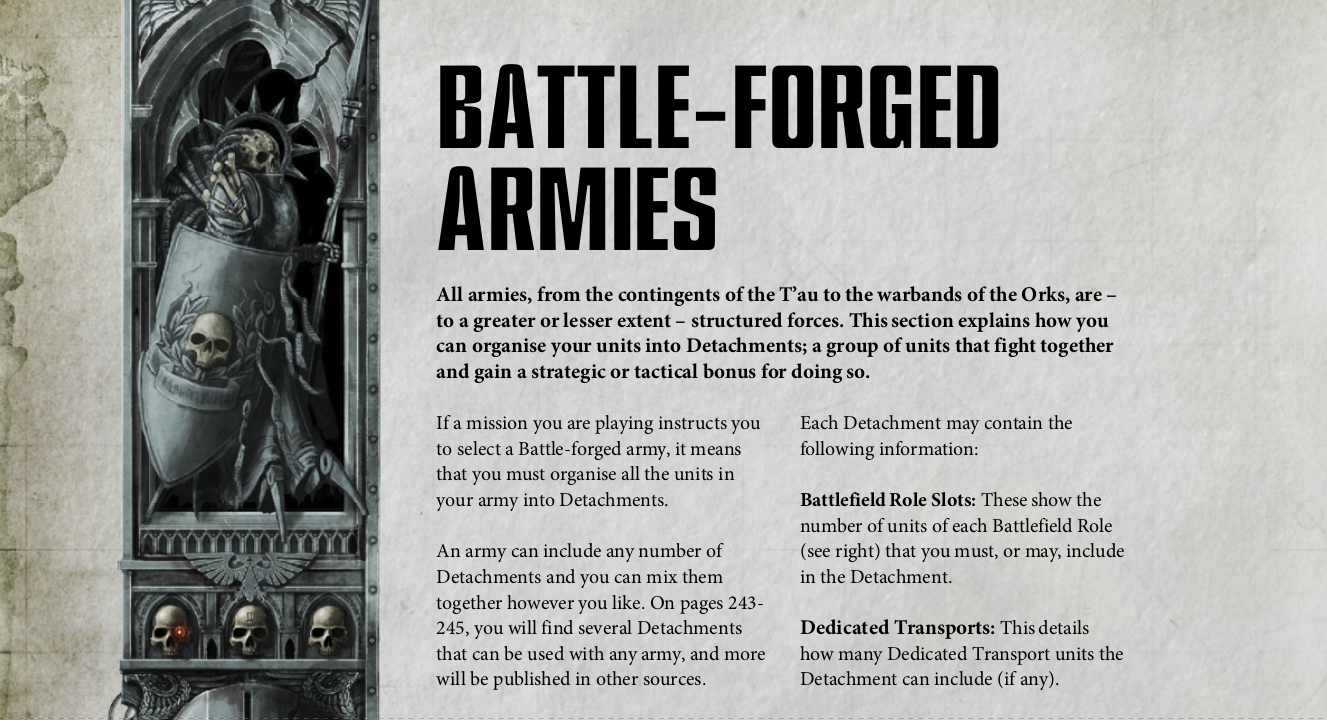
Matched Play requires that your armies be Battle Forged (main rulebook page 214, top left). Battle Forged requires your entire army to be organized into one or more detachments (main rulebook page 240, top left).

Beginning of the Battle Forged rules.

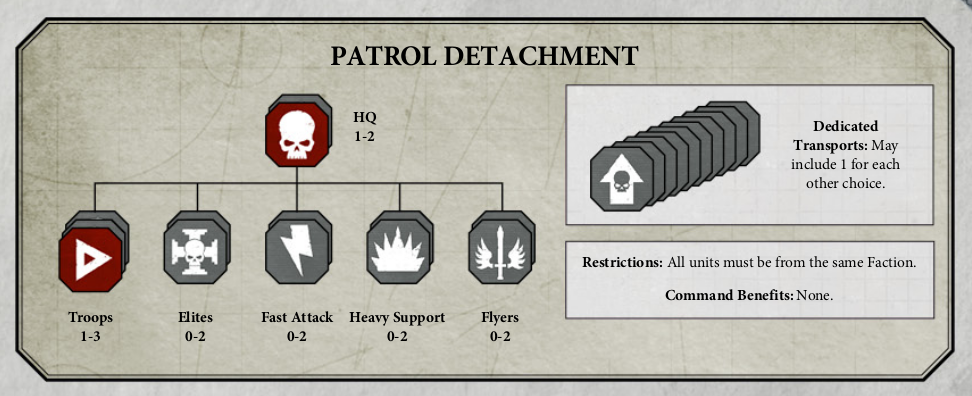
Detachments in theory are wide open, you can put any mix of units in there. However, in practice all of the units within a detachment must share at least one keyword. All of the detachments in the main rulebook such as Patrol, Battalion, Outrider, and so on either explicitly impose that restriction or are limited to a single unit. The only exception is the Fortification Network, which permits multiple fortifications with no faction restriction. There are some faction specific fortifications out right now, such as the Tau Tidewall, but most published so far are Unaligned (the commonly seen ones are all in Index Imperium 2), and this is mostly a small side point anyway.

Unless I’ve missed something, no other detachments have been published or rumored. So, in the future some supplement or such could perhaps have a detachment that permitted you to include Orks and Imperial Guard within a single detachment. However, you cannot do that within any of the detachments that currently exist because those units do not share any faction keywords. What you can do though is, for example, make up a detachment of Imperial Guard and Ultramarines units, because those all share at least one faction keyword (Imperium).

The Patrol detachment.

In addition, under Battle Forged rules alone, your army could straddle factions across multiple detachments. You could, for example, make up a Battle Forged army that had two detachments of Imperial Guard and one of Orks. There are no rules for Battle Forged armies linking the detachments.

Matched Play

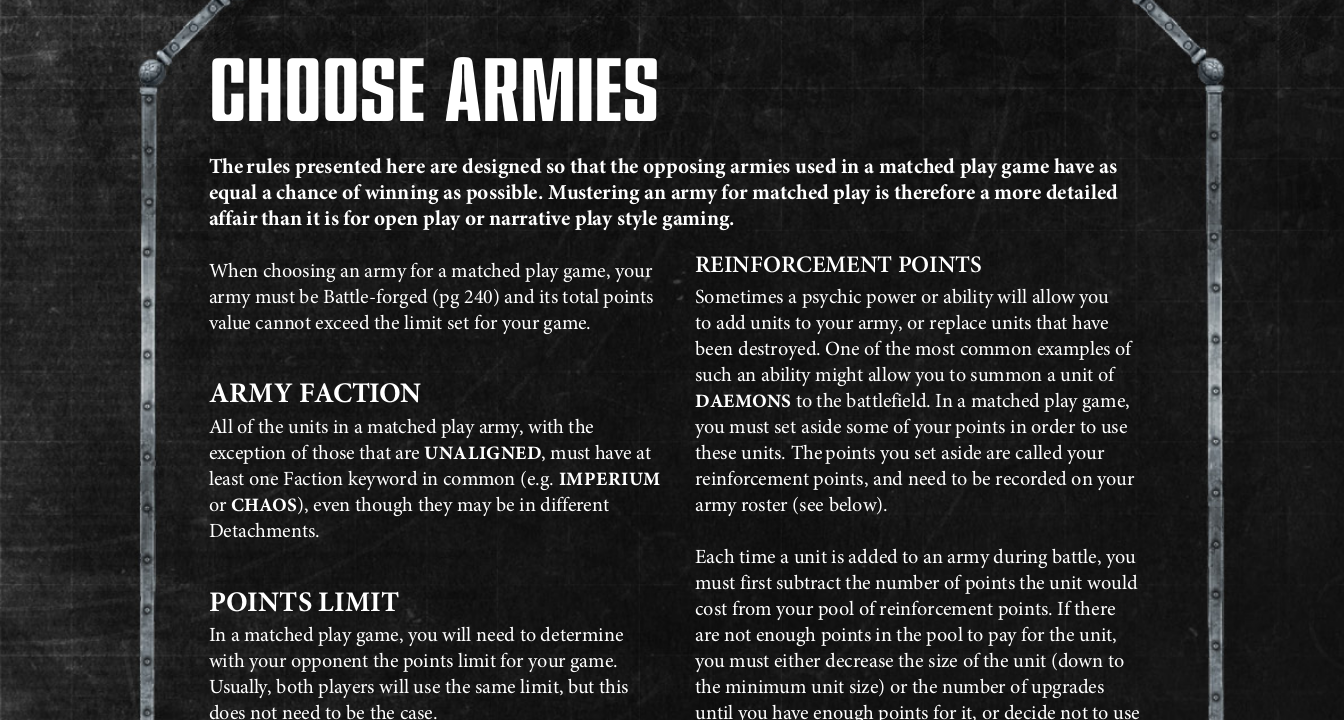
However, Matched Play prohibits that by imposing such a linkage. Matched Play requires that armies be Battle Forged and that all units have at least one faction keyword in common (main rulebook page 214, under “Army Faction”).

So, in a tournament or pickup play using Matched Play rules, you could not field an army with detachments of Imperial Guard and Orks even though it was Battle Forged. You can however still mix Imperial Guard and Ultramarines units within and across detachments, because those all share at least one keyword.

Beginning of Matched Play rules.

Faction Buffs

New rules from the codexes released to date as well as the upcoming Chapter Approved supplement however encourage—but do not require—detachments drawn from a single faction by offering at least four types of buffs for doing so.

Objective Secured

The codexes seen so far all have rules, such as the Space Marines’ Defenders of Humanity, that give a scoped but important buff to models in a detachment comprised solely of units from that codex: They trump other models for control of objectives. The Chapter Approved supplement will provide a similar rule, Objective Secured, for all the factions that still only have Indexes. Most events seem to be adopting this and the other updates to Matched Play from this supplement that have been officially previewed. There’s a reason GW rushed out these rules previews just in time for the first really large 40k event under 8th edition (NOVA): They address a number of balance issues, particularly as the codexes roll out.

Preview of Objective Secured rule from the upcoming Chapter Approved.

Stratagems

Similarly, codex stratagems are unlocked by fielding at least one detachment comprised solely of units from that codex. So a detachment made up of Imperial Guard and Space Marines would be Battle Forged, share a keyword, and be legal in Matched Play, but by itself it would not have access to either of those codexes’ stratagems. That’s a severe penalty for mixing the factions given the utility of some of those, so it’s another strong incentive to field uniform detachments.

Chapter Tactics

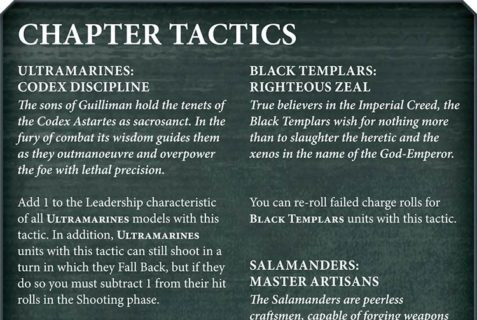
All of the codexes released or previewed to date have also granted additional unique benefits to detachments comprised solely of particular factions: Space Marine detachments made up of a single chapter receive an associated Chapter Tactic, Grey Knights have a Chapter Tactic in Brotherhood of Psykers, and Chaos Space Marine legions all have their own benefits. Future codexes will grant similar unique benefits to detachments made up of specific regiments, dynasties, forge worlds, clans, etc..

Some of the Space Marines’ Chapter Tactics.

Units

Finally, most unit special abilities affecting other units are also compatible only with the most specific factions. Transports in the mainline indexes and codexes can only embark units drawn from the same chapter or that codex’s equivalent. Captains, honor guards, ancients, and similar generate aura buffs only applicable to units and models from their specific chapter or equivalent. There are some notable exceptions, such as Guilliman, who provides an aura at the Imperium level. But in general while detachments made of various factions under an umbrella faction are valid in Matched Play, their units will be limited in how they interoperate and support each other.

In some sense this incentive is not very strong. You might only be planning on those units interacting with a few other units anyway. But unlike the Objective Secured and Chapter Tactics type buffs it is diffused across the entire army, creating a soft linkage between detachments: Sure would be a bummer if at some point in a game a unit in one detachment really needed to embark a transport or receive some buff from a unit in another detachment but couldn’t because they were of different factions (detachment boundaries alone do not impair such abilities). So the tighter faction scoping of most unit abilities in this edition also gently encourages focusing on one or a limited number of factions, even between detachments.

Fluff

By and large though the explicit faction-focus benefits so far are primarily encouraging uniform detachments, not armies. You could still mix factions between detachments, provided they all have at least one shared faction keyword, and get these buffs. So, as long as our example Imperial Guard and Ultramarines army was organized into detachments each with uniform faction, they would all have Objective Secured or Defenders of Humanity respectively, access to their stratagems, the Ultramarines would get their Chapter Tactic, and when their codex arrives the Imperial Guard will get some benefit associated with the chosen regiment.

Matched Play rules therefore impose basic requirements prohibiting very unfluffy combinations. You can’t field Orks and Imperial Guard together. But within a larger alliance such as Imperium or Chaos you have a great deal of flexibility, certainly across an army and even within detachments. However, there are multiple strong incentives for focusing detachments at least on particular specific factions. Unit level interactions and combos are also much more constrained. Taking all of these rules together, in 8th edition you won’t see anything nearly as crazy as the allies permitted in the recent prior editions, and many armies will in fact be very traditional.

Limited Detachments

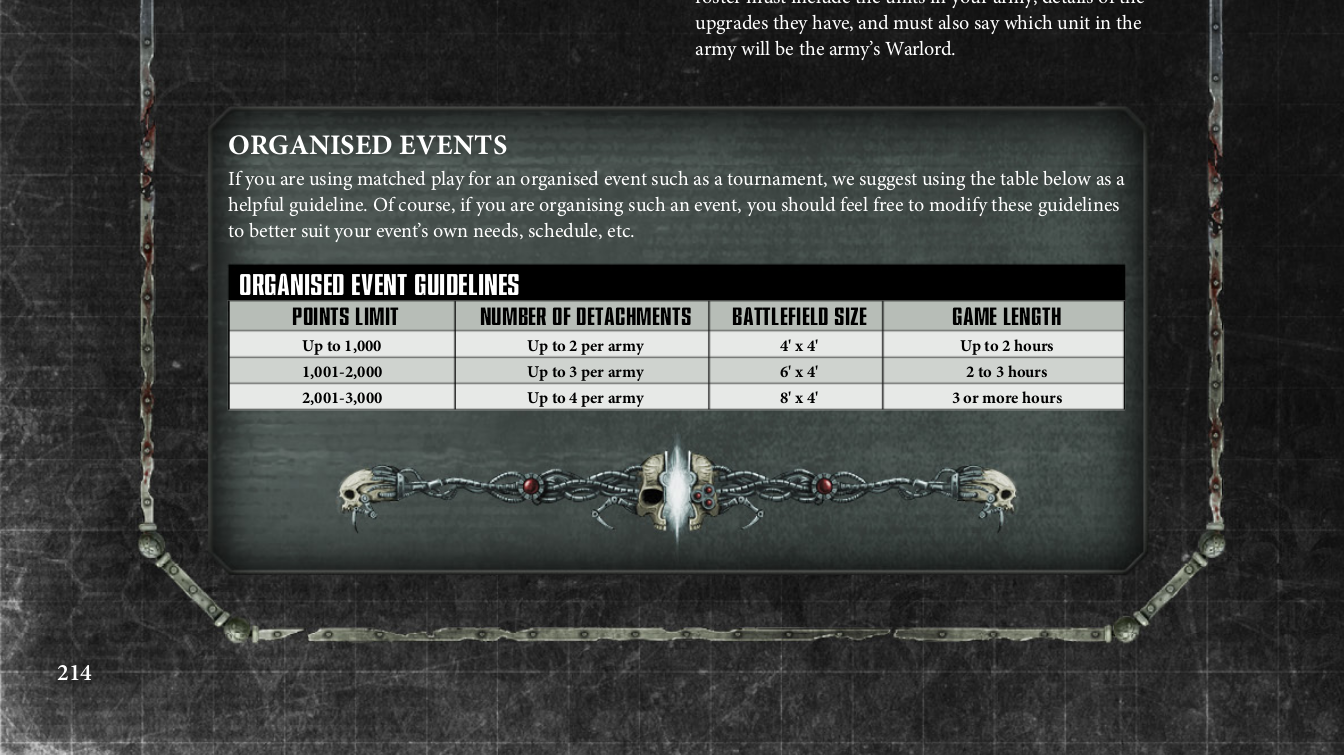
One last general note is that most events are limiting the number of detachments that may be taken. Matched Play provides a table of suggestions (main rulebook bottom of page 214) which have been widely adopted. So at the new standards of 1500 or 2000 points, armies are generally restricted to 3 detachments.

Suggested detachment count limits.

Conclusion

In sum, the rules for allies and army organization in Matched Play are somewhat confusingly presented as they’re located in a variety of places throughout the 40k main rulebook. But in practice they’re pretty simple: Armies must be made up of detachments, every unit across an army must be from the same general faction, and there are buffs for detachments selected from a single specific faction.

Footnote

It is a detailed rules design topic not especially applicable to actually playing, but this post discusses duplication and ambiguity problems in the rules around Objective Secured and Space Marine Detachment.

2016 Book, Music, & Film Highlights

With 2017 two-thirds over, I feel it’s safe to put up my 2016 book, music, and movie/TV highlights without fear of temporal-proximity bias…

Books

In some sense the “best” books I read in 2016 were—

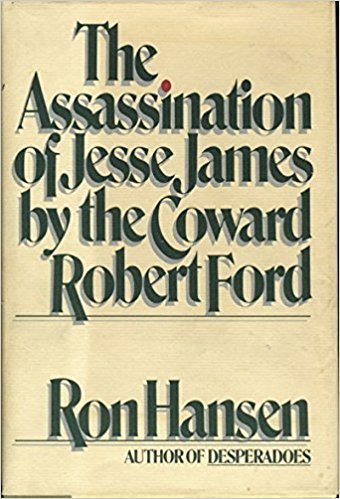
  • The Assassination of Jesse James By The Coward Robert Ford by Hansen. Novelization of the end of Jesse James, later turned into an excellent film. Difficult to read James in anything but Brad Pitt’s voice & face now, but that’s ok, the movie was pretty good. The novel has a somewhat detached, documentary feel to it, just like the movie does. That works well though for the gritty, mean, enclosed lives all the characters lead. Sits well with James’ belief in out-of-the-body travel as well. The climax comes somewhat early, but the closing sections are just as good. They’re basically a quick retelling of Deadwood, with different historical characters. Very different themes throughout the book from an actual “Western.” There’s relatively little about the landscape, freedom, etc.. These guys are just all about easy money and killing, and they die cheaply and often because of it. The really big question set out implicitly by the novel is just how much did James plan and foster this end? Not just at the last moments, but from the very start?
  • No Country For Old Men by McCarthy. Excellent read about a drug deal gone bad and the multi-layered pursuit set off across city and desert. The film portrays the novel impressively and very faithfully. Notably, like in his other books, McCarthy does a lot with syntax and presentation to make the whole setting feel really off, and I think the film does similar via techniques like using music very sparingly. Both of them do a lot of things like only show you the aftermath of a scene, not the actual fight, etc.. In the film version there’s basically 1 minor character cut, a little bit of backstory cut from the Sheriff, and 1 death changed in a small but critical detail. Otherwise it’s almost identical in any meaningful comparison.

However, the book that stuck with me the most is:

  • Flight Behavior by Kingsolver. An interesting novel about climate change as well as science and elite society from the view of the downtrodden. I didn’t know anything about the story going in, so I had no idea where it was going until a good bit in. I recommend that approach to heighten the soft air of rural fantasy. By the end the novel gets very preachy and overt, but overall it’s still interesting.

Flight Behavior definitely gets too heavy handed by the end. However I really liked the perspective of poor rural people looking at not just scientists, but the scientific enterprise. The characters generally all feel well realized and have stuck in mind longer than I expected for such a quiet, uneventful story.

Music

The household pre-k contingent’s vote for music of of the year is Feist’s visit to Sesame Street and subsequent rendition of 1, 2, 3, 4:

New-to-me music I listened to the most this year includes:

“Best” of the year though for me I would have to say are:

Jidenna’s brief appearance was by far the highlight of Netflix’s so-so Luke Cage series, which is how I really came across him (no doubt like many others).

Sleeping At Last is kind of fascinating as a business/music venture. It’s basically one guy who had some early mainstream success promoted by Smashing Pumpkins, but has since backed off into steady, smaller releases. Much of his ongoing commercial success seems to come from covers he does, as well as his own music, being used frequently in TV shows. Along the way though he’s been developing this concept compilation Atlas, which I believe is now spread across multiple volume-years, which includes East and Sun. East to me is a great sketch in the styling of a young children’s book of an adult looking back at life. Sun is the song I’ve found that best captures the feeling of being a parent looking at your child.

Film

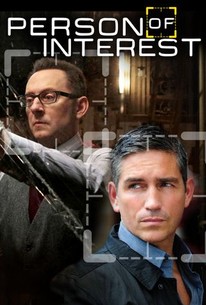
Standouts from previous years’ highlights, both Justified and Person of Interest came to an end in 2016. Both actually managed to conclude very satisfactorily. I highly recommend both series in their entirety.
Other quick mentions: I finally saw The Martian and thought it entertaining and shiny, but not super memorable; the book left me feeling the same. The Expanse I really enjoyed and thought it much much better than the novel(s) because it provided more depth and background to a number of characters, e.g., notably the Martians from the Donnager. The Big Short stuck with me due to all the arguably autistic and asocial personalities.

TV

In episodic viewing: Better Call Saul I really liked and thought masterfully done, but have had an extremely hard time following it into Season 2 because Saul is just so relentlessly self-defeating.

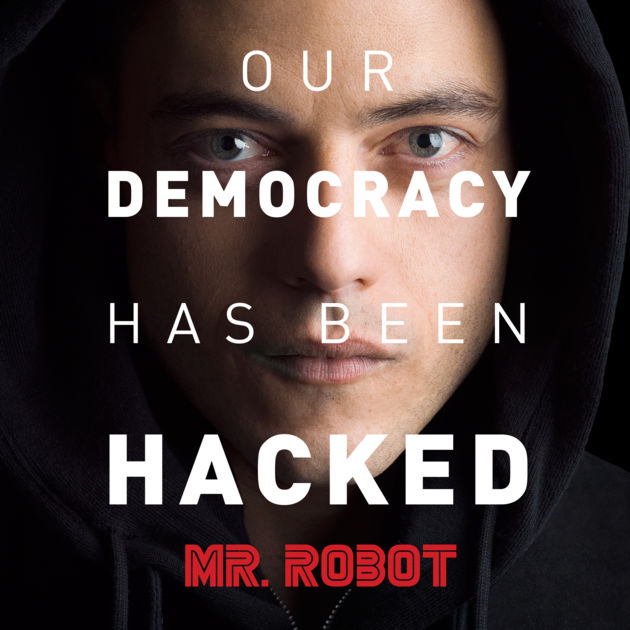
I’ve felt somewhat similarly about Mr Robot. The first season was incredible and I recommend it highly. It does an excellent job at atmosphere and traditional but just short of annoyingly cliched hackers. The ostensible big reveal was too heavily telegraphed to be actually surprising, but the whole show is so well done that its appeal wasn’t diminished. It’s still worth revisiting earlier scenes and re-evaluating in that context. All that said, I have not yet watched the follow-on season(s) because I just don’t know if they’re necessary. Sure there’s more plot to unravel, but do I really care? The show is all about characters, not plot, and I feel like I already got from them what I wanted.

Sidenote: For a very good 7-minute riff on the hackers/finance side of Mr Robot, check out this Axel Thesleff music video for Bad Karma:

Movies

Rounding out my highlights for 2016 are two really excellent movies—

Rogue One. My favorite Star Wars movie, and possibly the best one. A timely recovery from the deeply lackluster second half of Force Awakens.

On first viewing I thought Rogue One moved too fast and there was both too much crammed in and yet not enough material. Subsequently though I’ve revisited that and think what’s there is largely what should be there. The movie is essentially a classic ensemble WW2 movie from the early ’60s, but with robots and lasers and executed with modern effects and pacing. A ton of character background isn’t needed, and if you watch closely we do get just enough for each of the main figures. We see Cassian kill two Rebel-aligned people. Chirrut notes that Baze used to be the most devout, and now the latter is clearly fighting heartbreak with jokes and pretending the temple didn’t fall. Rook we know a lot about: He was an Imperial pilot, he spent time with Galen, he had a conversion just like tons of famous Rebel figures. There is more supported explicitly by the text of the movie than it might at first seem. It just moves along so quickly that it’s easy to miss.

That said, I do think the movie needed just a few minutes of Jyn fighting with Gerrera and his terrorists, establishing her as both a true Rebel and a natural leader. Her emergence at the end as a militant freedom fighter and inspiring figure then wouldn’t be an abrupt shift but rather a return to her roots and neglected abilities. Again, you can see some of this in what is actually present in the movie, e.g., how heads turn in the transport headed in to the final battle when she says she fought alongside Gerrera. But that background could stand to be conveyed on screen more fully. It would also flesh out the rich sketch of Gerrera and his supporting figures quite a lot.

That shortcoming aside, Rogue One is a great, self-contained, satisfying story that is all the better for not being required to leave enough openings for continued spin-offs and sequels. It fits almost perfectly into A New Hope, setting the stage for that story and filling in many details to reward fans (e.g., the death of Red 5 creating a slot in the pilot roster for Luke), but stands very well on its own as a classic ensemble war movie set in the Star Wars universe. Bonus points for the female lead and ethnic character diversity.

Arrival. I saw this movie somewhat randomly, and don’t think it really needs to be seen in theaters but was glad I did. A quiet, understated film that really has a lot going on. A number of scenes really stuck with me well afterward, most especially the pivotal scene with the Chinese general at the party. This was an instant sci-fi classic that should also have broader appeal.

A small but important note, I appreciated that the aliens are vague and yet very concrete. There’s a very fine balance to this kind of alien presence and I think most movies don’t do nearly as well. Far too often they’re either too abstract or too human, too understandable or too random. Giant elephant-skinned squid things in the mist is among the best presentations I’ve seen for this kind of story.

It should also not go unemphasized that this is a movie about communication. Of course up front it’s about communicating with the aliens. But again and again Arrival hits that theme in big and small ways: The governments all cutting off discussion with each other, the troops not knowing what’s going on, the Chinese general keying in on his wife’s last words. Most importantly, much of the subtext is about Ian’s inability to communicate and express himself. This gets hits just a couple times, quietly, most notably when he explicitly says something to the effect of if he had to do it all over again he wishes he would express himself better, and again when it becomes clear they break up because he can’t talk about how Louisa could have their baby knowing what would happen. This thick layering of the theme of communication elevates Arrival from a very good sci-fi movie to a good movie above genre.

Bonus points again for the female scientist lead. On that note, Arrival is an excellent heir to Contact, which over time has unexpectedly become one of my favorite movies. They’re remarkably similar without in any way being duplicative: Two great sci-fi movies, with strong female scientist leads, that are all about communication both in the surface story and in the sub-plot relationships between people. Each warrants both repeat and general audience viewing.

It came somewhat unheralded out of nowhere, but I found Arrival deeply satisfying and engrossing, and it was certainly my movie highlight of 2016.